
|
You entered: planets
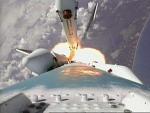 Launch of the Spirit Rover Toward Mars
28.07.2003
Next stop: Mars. Last month the first of two missions to Mars was launched from Cape Canaveral, Florida, USA above a Boeing Delta II rocket. Pictured above, solid fuel boosters are seen falling away as light from residual exhaust is reflected by the soaring rocket.
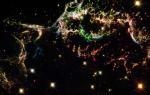 Recycling Cassiopeia A
30.08.2003
For billions of years, massive stars in our Milky Way Galaxy have lived spectacular lives. Collapsing from vast cosmic clouds, their nuclear furnaces ignite and create heavy elements in their cores. After a few million years, the enriched material is blasted back into interstellar space where star formation begins anew.
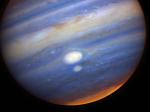 Jupiters Two Largest Storms Nearly Collide
25.07.2006
Two storms systems larger than Earth are nearly colliding right now on planet Jupiter. No one was sure what would happen, but so far both storms have survived. In the above false-color infrared image...
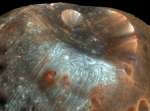 Stickney Crater
10.04.2008
Stickney Crater, the largest crater on the martian moon Phobos, is named for Chloe Angeline Stickney Hall, mathematician and wife of astronomer Asaph Hall. Asaph Hall discovered both the Red Planet's moons in 1877.
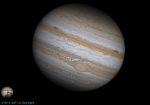 Jupiter Rotation Movie from Pic du Midi
6.12.2011
Observe the graceful twirl of the Solar System's largest planet. Many interesting features of Jupiter's enigmatic atmosphere, including dark bands and light zones, can be followed in detail. A careful inspection will reveal that central clouds rotate slightly faster than clouds toward the poles.
 The Swirling Core of the Crab Nebula
8.07.2016
At the core of the Crab Nebula lies a city-sized, magnetized neutron star spinning 30 times a second. Known as the Crab Pulsar, it's actually the rightmost of two bright stars, just below a central swirl in this stunning Hubble snapshot of the nebula's core.
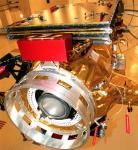 Full Throttle For Deep Space 1
31.08.2000
At full throttle the Deep Space 1 spacecraft's innovative ion drive produces about 1/50th of a pound of thrust ... a force so great that it would just about hold up a piece of paper on planet Earth! Still, powered by solar arrays ion propulsion systems can run continuously.
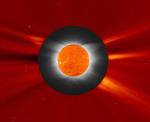 Solar Eclipse and SOHO
31.03.2006
Neither rain, nor snow, nor dark of night can keep the space-based SOlar Heliospheric Observatory (SOHO) from watching the Sun. In fact, from its vantage point 150 million kilometers sunward of planet Earth, SOHO's cameras can always monitor the Sun's outer atmosphere, or corona.
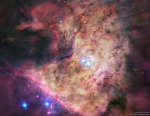 Trapezium: At the Heart of Orion
5.08.2018
Near the center of this sharp cosmic portrait, at the heart of the Orion Nebula, are four hot, massive stars known as the Trapezium. Gathered within a region about 1.5 light-years in radius, they dominate the core of the dense Orion Nebula Star Cluster.
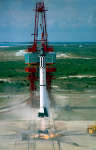 Mercury Redstone 3 Launch
7.05.2021
Sixty years ago, near the dawn of the space age, NASA controllers "lit the candle" and sent Mercury astronaut Alan Shepard arcing into space atop a Redstone rocket. His cramped space capsule was dubbed Freedom 7.
|
January February March April May June July August |
||||||||||||||||||||||||||||||||||||||||||||||||||||||||