
|
You entered: Sun
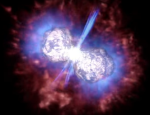 Eta Car: 3D Model of the Most Dangerous Star Known
9.02.2022
What's the most dangerous star near earth? Many believe it's Eta Carinae, a binary star system about 100 times the mass of the Sun, just 10,000 light years from earth.
 Webb s Rho Ophiuchi
13.07.2023
A mere 390 light-years away, Sun-like stars and future planetary systems are forming in the Rho Ophiuchi molecular cloud complex, the closest star-forming region to our fair planet. The James Webb Space Telescope's NIRCam peered into the nearby natal chaos to capture this infrared image at an inspiring scale.
 Eclipse Pair
3.01.2025
Eclipses tend to come in pairs. Twice a year, during an eclipse season that lasts about 34 days, Sun, Moon, and Earth can nearly align. Then the full and new phases of the Moon, separated by just over 14 days, create a lunar and a solar eclipse.
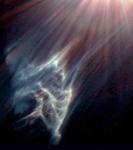 Reflecting Merope
6.12.2000
In the famous Pleiades star cluster, a star's light is slowly destroying a passing cloud of gas and dust. The star, Merope, lies just off the upper right edge of this recently released picture by the Hubble Space Telescope.
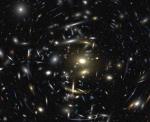 Simulated Galaxy Cluster View
6.03.2002
Stunningly detailed, this picture is a computer simulated view of a cluster of galaxies in the distant cosmos. A large, elliptical galaxy dominates this hypothetical cluster's central region surrounded by a swarm of member galaxies.
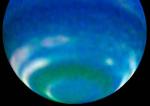 Neptune: Still Springtime After All These Years
13.06.2003
In the 1960s spring came to the southern hemisphere of Neptune, the Solar System's outermost gas giant planet. Of course, since Neptune orbits the Sun once every 165 earth-years, it's still spring for southern Neptune, where each season lasts over four decades.
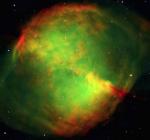 M27: Not A Comet
23.10.1999
While searching the skies above 18th century France for comets, astronomer Charles Messier diligently recorded this object as number 27 on his list of things which are definitely not comets. So what is it?
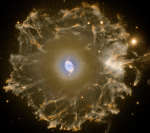 Halo of the Cats Eye
9.05.2010
The Cat's Eye Nebula (NGC 6543) is one of the best known planetary nebulae in the sky. Its haunting symmetries are seen in the very central region of this stunning false-color picture, processed...
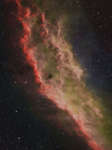 NGC 1499: The California Nebula
2.03.2011
What's California doing in space? Drifting through the Orion Arm of the spiral Milky Way Galaxy, this cosmic cloud by chance echoes the outline of California on the west coast of the United States.
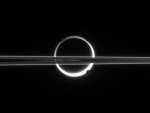 Saturn, Titan, Rings, and Haze
29.07.2013
This is not a solar eclipse. Pictured above is a busy vista of moons and rings taken at Saturn. The large circular object in the center of the image is Titan, the largest moon of Saturn and one of the most intriguing objects in the entire Solar System.
|
January February March April May June July August September |
|||||||||||||||||||||||||||||||||||||||||||||||||