
|
You entered: Sun
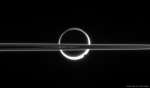 Saturn, Titan, Rings, and Haze
5.05.2019
This is not a solar eclipse. Pictured here is a busy vista of moons and rings taken at Saturn. The large circular object in the center of the image is Titan, the largest moon of Saturn and one of the most intriguing objects in the entire Solar System.
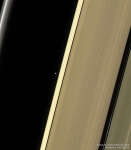 Earth and Moon through Saturns Rings
27.05.2020
What are those dots between Saturn's rings? Our Earth and Moon. Just over three years ago, because the Sun was temporarily blocked by the body of Saturn, the robotic Cassini spacecraft was able to look toward the inner Solar System.
 Shadows at the Moons South Pole
10.04.2022
Was this image of the Moon's surface taken with a microscope? No -- it's a multi-temporal illumination map made with a wide-angle camera. To create it, the Lunar Reconnaissance Orbiter spacecraft collected...
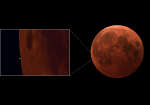 Blood Moon, Ice Giant
11.11.2022
On November 8 the Full Moon turned blood red as it slid through Earth's shadow in a beautiful total lunar eclipse. During totality it also passed in front of, or occulted, outer planet Uranus for eclipse viewers located in parts of northern America and Asia.
 APOD: 2023 October 3 Б MyCn 18: The Engraved Hourglass Planetary Nebula
3.10.2023
Do you see the hourglass shape -- or does it see you? If you can picture it, the rings of MyCn 18 trace the outline of an hourglass -- although one with an unusual eye in its center. Either way, the sands of time are running out for the central star of this hourglass-shaped planetary nebula.
 APOD: 2023 December 5 Б Energetic Particle Strikes the Earth
5.12.2023
It was one of the most energetic particles ever known to strike the Earth -- but where did it come from? Dubbed Amaterasu after the Shinto sun goddess, this particle, as do all cosmic rays...
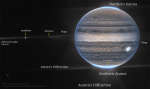 APOD: 2026 January 18 Б Jupiter from the Webb Space Telescope
18.01.2026
This infrared view of Jupiter by Webb is illuminating. High-resolution infrared images of Jupiter from the James Webb Space Telescope (Webb) reveal, for example, differences between high-floating bright clouds -- including the Great Red Spot -- and low-lying dark clouds.
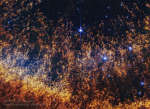 APOD: 2026 August 4 Б Curious Cometary Knots in the Helix Nebula
4.08.2026
What causes unusual knots of gas and dust in planetary nebulas? Seen also in the Ring Nebula, the Dumbbell Nebula and NGC 2392, the knots' existence was not initially predicted, and their origins are still not well understood.
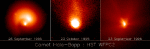 Comet Hale-Bopp Inbound
19.12.1996
Headed toward the inner Solar System, the much anticipated Comet Hale-Bopp has promised to put on a big show next spring. The comet's apparent brightness is currently approaching 4th magnitude and its inbound journey has been closely followed by many observers.
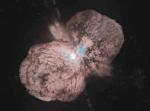 Doomed Star Eta Carinae
28.11.2004
Eta Carinae may be about to explode. But no one knows when - it may be next year, it may be one million years from now. Eta Carinae's mass - about 100 times greater than our Sun - makes it an excellent candidate for a full blown supernova.
|
January February March April May June July August September |
|||||||||||||||||||||||||||||||||||||||||||||||||