
|
You entered: stars
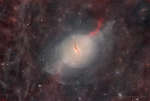 APOD: 2026 March 30 Б Peculiar Elliptical Galaxy Centaurus A
30.03.2026
What's happened to the center of this galaxy? Dramatic dust lanes run across the center of unusual elliptical galaxy Centaurus A. These dust lanes are so thick they almost completely obscure the galaxy's center in visible light.
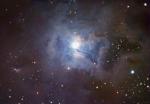 NGC 7023: The Iris Nebula
4.11.2004
Like delicate cosmic petals, these clouds of interstellar dust and gas have blossomed 1,300 light-years away in the fertile star fields of the constellation Cepheus. Sometimes called the Iris Nebula and dutifully cataloged as NGC 7023, this is not the only nebula in the sky to evoke the imagery of flowers.
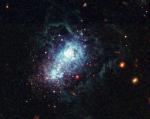 I Zwicky 18: Young Galaxy
3.12.2004
The Milky Way is an ordinary 12 billion year old spiral galaxy, and even our middle-aged Sun is pushing 4.5 billion years. But all the stars in dwarf galaxy I Zwicky 18 are much younger.
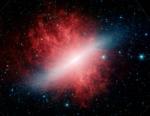 Smoke from the Cigar Galaxy
14.04.2006
Very bright in infrared light, well-known starburst galaxy M82's popular name describes its suggestive shape seen at visible wavelengths - The Cigar Galaxy. Ironically, M82's fantastic appearance in this Spitzer Space Telescope image...
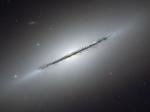 Edge On Galaxy NGC 5866
12.06.2006
Why is this galaxy so thin? Many disk galaxies are actually just as thin as NGC 5866, pictured above, but are not seen edge-on from our vantage point. One galaxy that is situated edge-on is our own Milky Way Galaxy.
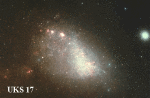 The Small Cloud of Magellan
19.09.1995
Almost unknown to casual observers in the northern hemisphere, the southern sky contains two diffuse wonders known as the Magellanic Clouds. The Magellanic Clouds are small irregular galaxies orbiting our own larger Milky Way spiral galaxy.
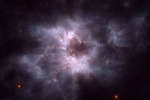 NGC 2440: Cocoon of a New White Dwarf
21.02.2010
Like a butterfly, a white dwarf star begins its life by casting off a cocoon that enclosed its former self. In this analogy, however, the Sun would be a caterpillar and the ejected shell of gas would become the prettiest of all!
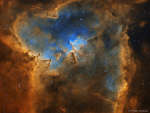 The Heart Nebula in Hydrogen, Oxygen, and Sulfur
27.08.2017
What powers the Heart Nebula? The large emission nebula dubbed IC 1805 looks, in whole, like a heart. The nebula's glow -- as well as the shape of the gas and dust clouds -- is powered by by stellar winds and radiation from massive hot stars in the nebula's newborn star cluster Melotte 15.
 The Planetary Nebula Show
14.06.2003
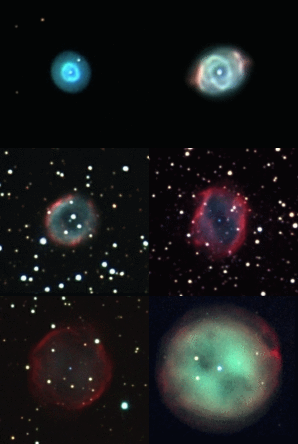
What do the Owl, the Cat's Eye, the Ghost of Jupiter, and Saturn have in common? They're all planetary nebulae of course, glowing gaseous shrouds shed by dying sun-like stars as they run out of nuclear fuel.
 Recycling Cassiopeia A
30.08.2003
For billions of years, massive stars in our Milky Way Galaxy have lived spectacular lives. Collapsing from vast cosmic clouds, their nuclear furnaces ignite and create heavy elements in their cores. After a few million years, the enriched material is blasted back into interstellar space where star formation begins anew.
|
January February March April May June July August September |
|||||||||||||||||||||||||||||||||||||||||||||||||