
|
You entered: stars
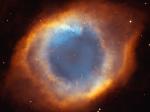 NGC 7293: The Helix Nebula
10.05.2003
Will our Sun look like this one day? The Helix Nebula is the closest example of a planetary nebula created at the end of the life of a Sun-like star. The outer gasses of the star expelled into space appear from our vantage point as if we are looking down a helix.
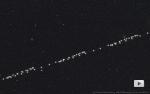 Three Years of Saturn
7.04.2007
Using an image recorded just last month as a base, this composite illustration tracks the motion of bright Saturn as it wanders through planet Earth's night sky. Starting at the upper right, Saturn's position is shown about every two weeks beginning in August 2005 and projected through September 2008.
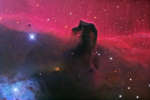 The Horsehead Nebula in Orion
26.11.2008
One of the most identifiable nebulae in the sky, the Horsehead Nebula in Orion, is part of a large, dark, molecular cloud. Also known as Barnard 33, the unusual shape was first discovered on a photographic plate in the late 1800s.
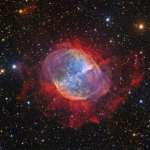 M27 Not a Comet
9.06.2017
While hunting for comets in the skies above 18th century France, astronomer Charles Messier diligently kept a list of the things he encountered that were definitely not comets. This is number 27 on his now famous not-a-comet list.
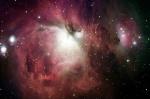 The Orion Nebula in Hydrogen
22.11.2000
The Great Nebula in Orion can be found just below and to the left of the easily identifiable belt of three stars in the popular constellation Orion. This fuzzy patch, visible to the unaided eye, contains one of the closest stellar nurseries, lying at a distance of about 1500 light years.
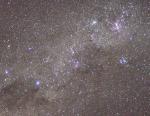 The Southern Sky from the International Space Station
7.05.2003
Look up from Earth's South Pole, and this stellar starscape is what you might see. Alternatively, this patch of sky is also visible from many southern locations as well as the orbiting International Space Station, where the above image was recently recorded.
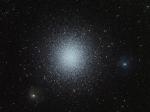 M13: The Great Globular Cluster in Hercules
11.05.2004
M13 is one of the most prominent and best known globular clusters. Visible with binoculars in the constellation of Hercules, M13 is frequently one of the first objects found by curious sky gazers seeking celestials wonders beyond normal human vision.
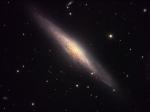 NGC 2683: Spiral Edge On
27.11.2004
This gorgeous island universe, cataloged as NGC 2683, lies a mere 16 million light-years distant in the northern constellation Lynx. A spiral galaxy comparable to our own Milky Way, NGC 2683 is seen nearly edge-on in this cosmic vista, with more distant galaxies scattered in the background.
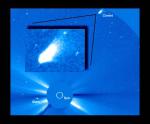 Discovery Image: Comet SOHO (1998 J1)
20.05.1998
Staring at the Sun from a vantage point in space (Kids, don't try this at home!), the Solar and Heliospheric Observatory (SOHO) has enabled the discovery of much about our closest star. It has also been used to discover about 50 comets.
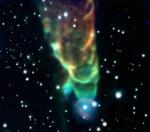 Cosmic Tornado HH 49 50
11.08.2007
Light-years in length, this cosmic tornado is actually a powerful jet cataloged as HH (Herbig-Haro) 49/50 blasting down from the top of a Spitzer Space Telescope view. Though such energetic outflows are well known...
|
January February March April May June July August September |
|||||||||||||||||||||||||||||||||||||||||||||||||