
|
You entered: ring
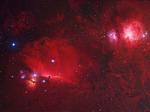 An Orion Deep Field
15.10.2006
Adrift 1,500 light-years away in one of the night sky's most recognizable constellations, the glowing Orion Nebula and the dark Horsehead Nebula are contrasting cosmic vistas. They both appear in this stunning composite digital image assembled from over 20 hours of data that includes exposures filtered to record emission from hydrogen atoms.
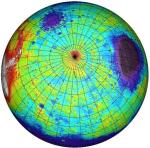 Southern Mars
2.12.1999
This topographical map of the southern hemisphere of Mars was generated using data from the Mars Orbiter Laser Altimeter (MOLA). Flying on the Mars Global Surveyor spacecraft, MOLA has bounced a laser beam off the Martian surface over 200,000,000 times producing a wealth of detailed elevation measurements.
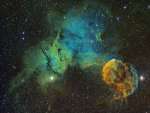 The Elusive Jellyfish Nebula
15.05.2010
Normally faint and elusive, the Jellyfish Nebula is caught in this alluring, false-color, telescopic view. Flanked by two bright stars, Mu and Eta Geminorum, at the foot of a celestial twin, the Jellyfish Nebula is the brighter arcing ridge of emission with dangling tentacles below and right of center.
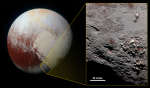 Wright Mons in Color
14.01.2016
Informally named Wright Mons, a broad mountain about 150 kilometers across and 4 kilometers high with a wide, deep summit depression is featured in this inset image captured during the New Horizons flyby of Pluto in July 2015.
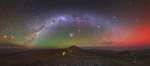 Milky Way with Airglow Australis
2.02.2017
Captured last April after sunset on a Chilean winter's night an exceptionally intense airglow flooded this scene. The panoramic skyscape is also filled with stars, clusters, and nebulae along the southern Milky Way including the Large and Small Magellanic clouds.
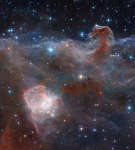 Horsehead: A Wider View
8.03.2018
Combined image data from the massive, ground-based VISTA telescope and the Hubble Space Telescope was used to create this wide perspective of the interstellar landscape surrounding the famous Horsehead Nebula. Captured at near-infrared wavelengths...
 The Ghosts of Gamma Cas
27.10.2023
Gamma Cassiopeiae shines high in northern autumn evening skies. It's the brightest spiky star in this telescopic field of view toward the constellation Cassiopeia. Gamma Cas shares the ethereal-looking scene with ghostly interstellar clouds of gas and dust, IC 59 (top left) and IC 63.
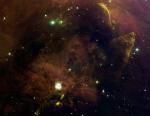 A Panorama of Oddities in Orion A
12.03.2000
New stars, fast jets, and shocked gas clouds all occupy Orion A, a giant molecular cloud just south of the Orion Nebula. The bright object visible below and slightly left of center of this recently released picture is the reflection nebula NGC 1999.
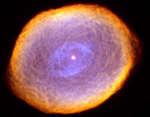 IC 418: The Spirograph Nebula
11.04.2010
What is creating the strange texture of IC 418? Dubbed the Spirograph Nebula for its resemblance to drawings from a cyclical drawing tool, planetary nebula IC 418 shows patterns that are not well understood. Perhaps they are related to chaotic winds from the variable central star, which changes brightness unpredictably in just a few hours.
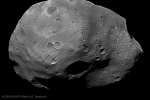 Phobos South Pole from Mars Express
23.01.2011
Where on this moon would you land? The moon pictured above is not Earth's moon but Phobos, the closest moon to the planet Mars. Phobos is so close to Mars that it is expected to break up and crash into the red planet within the next 100 million years.
|
January February March April May June July August September |
|||||||||||||||||||||||||||||||||||||||||||||||||