
|
You entered: ring
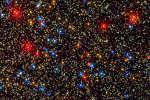 The Center of Globular Cluster Omega Centauri
14.09.2009
What is left over after stars collide? To help answer this question, astronomers have been studying the center of the most massive ball of stars in our Milky Way Galaxy. In the center of globular cluster Omega Centauri, stars are packed in 10,000 times more densely than near our Sun.
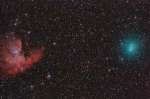 Pacman and Hartley
7.10.2010
Touring the solar system with a 6 year orbital period, small comet Hartley 2 (103/P Hartley) will make its closest approach to planet Earth on October 20 and its closest approach to the Sun on October 28. It may become a naked-eye comet, just visible in clear, dark skies.
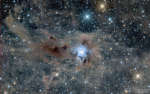 The Iris Nebula in a Field of Dust
1.08.2018
What blue flower grows in this field of dark interstellar dust? The Iris Nebula. The striking blue color of the Iris Nebula is created by light from the bright star SAO 19158 reflecting off of a dense patch of normally dark dust.
 Flemings Triangular Wisp
27.07.2021
Chaotic in appearance, these tangled filaments of shocked, glowing gas are spread across planet Earth's sky toward the constellation of Cygnus as part of the Veil Nebula. The Veil Nebula itself is a large supernova remnant, an expanding cloud born of the death explosion of a massive star.
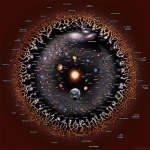 The Observable Universe
16.03.2022
How far can you see? Everything you can see, and everything you could possibly see, right now, assuming your eyes could detect all types of radiations around you -- is the observable universe. In light...
 Full Moon, Full Mars
18.01.2025
On January 13 a Full Moon and a Full Mars were close, both bright and opposite the Sun in planet Earth's sky. In fact Mars was occulted, passing behind the Moon, when viewed from some locations in North America and northwest Africa.
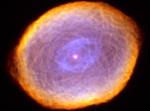 IC 418: The Spirograph Nebula
14.12.2002
What is creating the strange texture of IC 418? Dubbed the Spirograph Nebula for its resemblance to drawings from a cyclical drawing tool, planetary nebula IC 418 shows patterns that are not well understood. Perhaps they are related to chaotic winds from the variable central star, which changes brightness unpredictably in just a few hours.
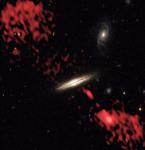 192: The Wrong Galaxy
14.01.2003
Centered above is distant galaxy 0313-192, some one billion light-years away. Radio emission from the galaxy has been mapped by the National Radio Astronomy Observatory's Very Large Array and is shown in red, composited with a visible light image from the Hubble Space Telescope's new Advanced Camera for Surveys.
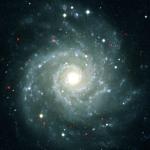 ULXs in M74
30.03.2005
In visual appearance, M74 is a nearly perfect face-on spiral galaxy, about 30 million light-years away toward the constellation Pisces. The red blotches seen in this composite view are ultraluminous x-ray sources (ULXs) mapped by the Chandra X-ray Observatory.
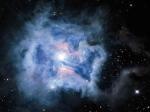 The Iris Nebula from CFHT
29.12.2005
Like delicate cosmic petals, these clouds of interstellar dust and gas have blossomed 1,300 light-years away in the fertile star fields of the constellation Cepheus. Sometimes called the Iris Nebula and dutifully cataloged as NGC 7023, this is not the only nebula in the sky to evoke the imagery of flowers.
|
January February March April May June July August September |
|||||||||||||||||||||||||||||||||||||||||||||||||