
|
You entered: time
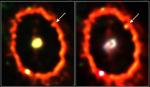 Shocked by Supernova 1987A
23.02.2002
Fifteen years ago today, the brightest supernova of modern times was sighted. Over time, astronomers have watched and waited for the expanding debris from this tremendous stellar explosion to crash into previously expelled material.
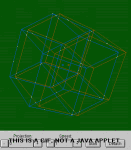 A Higher Dimensional Universe
18.04.2001
Does our universe have higher but unusual spatial dimensions? This idea has been gaining popularity to help explain why vastly separated parts of our universe appear so similar, and why the geometry of our universe does not seem to result naturally from the amounts of matter it
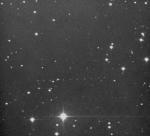 Cassini Flyby
26.08.1999
Connect the dots and you'll trace the path of the Cassini spacecraft as it took a final turn by Earth on its way to the outer solar system. The dots (in a horizontal row just below center) are actually successive images of the spacecraft.
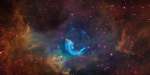 Approaching the Bubble Nebula
31.05.2017
What would it look like to approach the Bubble Nebula? Blown by the wind and radiation from a massive star, this bubble now spans seven light-years in diameter. The hot star inside is thousands of times more luminous than our Sun, and is now offset from the nebula's center.
 Afternoon Analemma
23.09.2023
An analemma is that figure-8 curve you get when you mark the position of the Sun at the same time each day for one year. To make this one, a 4x5 pinhole camera was set up looking north in southern New Zealand skies.
 APOD: 2025 May 20 Б Milky Way over Maunakea
20.05.2025
Have you ever seen the band of our Milky Way Galaxy? In a clear sky from a dark location at the right time, a faint band of light becomes visible across the sky. Soon after your eyes become dark adapted, you might spot the band for the first time. It may then become obvious.
 APOD: 2025 August 6 Б Meteor before Galaxy
6.08.2025
What's that green streak in front of the Andromeda galaxy? A meteor. While photographing the Andromeda galaxy in 2016, near the peak of the Perseid Meteor Shower, a small pebble from deep space crossed right in front of our Milky Way Galaxy's far-distant companion.
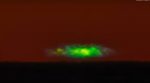 Video of a Green Flash
10.11.2021
Many think it is just a myth. Others think it is true but its cause isn't known. Adventurers pride themselves on having seen it. It's a green flash from the Sun. The truth is the green flash does exist and its cause is well understood.
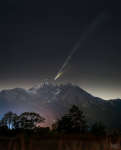 APOD: 2025 November 4 Б Comet Lemmon Beyond Lomnickц Peak
4.11.2025
Comet Lemmon has been putting on a show for cameras around the globe. Passing nearest to Earth in late October, the photogenic comet C/2025 A6 (Lemmon) sprouted two long and picturesque tails: a blue ion tail and a white dust tail.
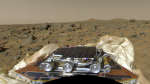 APOD: 2026 July 4 Б Pathfinder on Mars
4.07.2026
On July 4th, 1997, using its own array of fireworks, a parachute, and a cocoon of airbags, the Mars Pathfinder spacecraft bounced like a giant beach ball at least 15 times before it came to rest on the surface of Mars at 10:07 AM Pacific Daylight Time.
|
January February March April May June July August September |
|||||||||||||||||||||||||||||||||||||||||||||||||