
|
You entered: time
 APOD: 2023 December 25 Б Cathedral, Mountain, Moon
24.12.2023
Single shots like this require planning. The first step is to realize that such an amazing triple-alignment actually takes place. The second step is to find the best location to photograph it. But it was the third step: being there at exactly the right time -- and when the sky was clear -- that was the hardest.
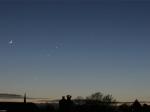 Mercury Over Leeds
6.03.2005
Have you ever seen the planet Mercury? This week might be a good time. Because Mercury orbits so close to the Sun, it never wanders far from the Sun in Earth's sky. If trailing the Sun, Mercury will be visible low on the horizon for only a short while after sunset.
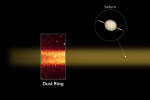 Giant Dust Ring Discovered Around Saturn
13.10.2009
What has created a large dust ring around Saturn? At over 200 times the radius of Saturn and over 50 times the radius of Saturn's expansive E ring, the newly discovered dust ring is the largest planetary ring yet imaged. The ring was found in infrared light by the Earth-orbiting Spitzer Space Telescope.
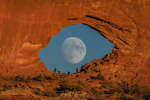 Eye of Moon
1.12.2020
Who's watching who? The featured image of the Moon through a gap in a wall of rock may appear like a giant eye looking back at you. Although, in late October, it took only a single exposure to capture this visual double, it also took a lot of planning.
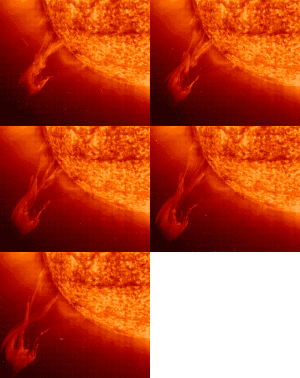 A Twisted Solar Eruptive Prominence
22.02.2003
A huge eruptive prominence is seen moving out from our Sun in this condensed half-hour time-lapse sequence. Ten Earths could easily fit in the "claw" of this seemingly solar monster. This large prominence, though, is significant not only for its size, but its shape.
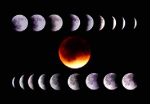 Tonight: A Total Lunar Eclipse
26.09.1996
Tonight brings the last total lunar eclipse visible from North America until the year 2000 - with the Moon becoming completely immersed in Earth's shadow. The above time-lapse photograph shows a lunar eclipse that occurred in April 1993.
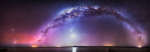 From the Northern to the Southern Cross
27.01.2014
There is a road that connects the Northern to the Southern Cross but you have to be at the right place and time to see it. The road, as pictured above, is actually...
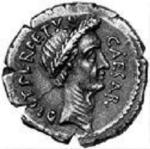 Julius Caesar and Leap Days
28.02.2000
Even as leap days go, today is a remarkable one. In 46 BC, Julius Caesar, pictured above in a self-decreed minted coin, created a calendar system that added one leap day every four years.
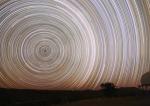 11 Hour Star Trails
15.09.2006
Fix your camera to a tripod, lock the shutter open, and you can make an image of star trails - graceful concentric arcs traced by the stars as planet Earth rotates on its axis. Of course, the length of the star trails will depend on the exposure time.
 Sun Block
18.08.1999
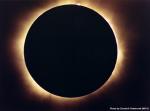
During a total solar eclipse, Earth's moon blocks the sun - almost exactly. While the sun is about 400 times wider than the moon, it is also about 400 times farther away and each appears to be half a degree or so in diameter.
|
January February March April May June July August September |
|||||||||||||||||||||||||||||||||||||||||||||||||