
|
You entered: ring
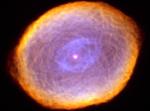 IC 418: The Spirograph Nebula
17.10.2004
What is creating the strange texture of IC 418? Dubbed the Spirograph Nebula for its resemblance to drawings from a cyclical drawing tool, planetary nebula IC 418 shows patterns that are not well understood. Perhaps they are related to chaotic winds from the variable central star, which changes brightness unpredictably in just a few hours.
 Everest Panorama from Mars
14.11.2005
If you could stand on Mars -- what might you see? Scroll right to find out. The robotic Spirit rover currently rolling across Mars climbed to the top of hill and took a series of images that were digitally combined into a 360 degree panorama over three days early last month.
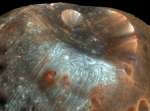 Stickney Crater
10.04.2008
Stickney Crater, the largest crater on the martian moon Phobos, is named for Chloe Angeline Stickney Hall, mathematician and wife of astronomer Asaph Hall. Asaph Hall discovered both the Red Planet's moons in 1877.
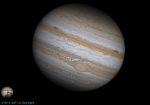 Jupiter Rotation Movie from Pic du Midi
6.12.2011
Observe the graceful twirl of the Solar System's largest planet. Many interesting features of Jupiter's enigmatic atmosphere, including dark bands and light zones, can be followed in detail. A careful inspection will reveal that central clouds rotate slightly faster than clouds toward the poles.
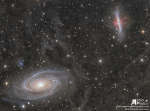 Galaxy Wars: M81 versus M82
3.02.2016
In the lower left corner, surrounded by blue spiral arms, is spiral galaxy M81. In the upper right corner, marked by red gas and dust clouds, is irregular galaxy M82. This stunning vista shows these two mammoth galaxies locked in gravitational combat, as they have been for the past billion years.
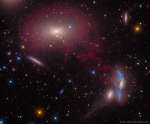 M86 in the Central Virgo Cluster
14.08.2018
Is there a bridge of gas connecting these two great galaxies? Quite possibly, but it is hard to be sure. M86 on the upper left is a giant elliptical galaxy near the center of the nearby Virgo Cluster of galaxies.
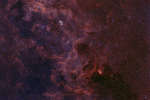 Cosmic Clouds in Cygnus
9.06.2022
These cosmic clouds of gas and dust drift through rich star fields along the plane of our Milky Way Galaxy toward the high flying constellation Cygnus. They're too faint to be seen with the unaided eye though, even on a clear, dark night.
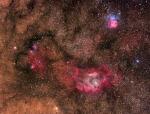 Sagittarius Triplet
14.06.2006
These three bright nebulae are often featured in telescopic tours of the constellation Sagittarius and the crowded starfields of the central Milky Way. In fact, 18th century cosmic tourist Charles Messier cataloged two of them; M8, the nebula below and right of center, and colorful M20 at the upper right.
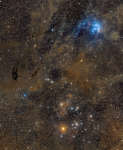 Pleiades to Hyades
6.12.2019
This cosmic vista stretches almost 20 degrees from top to bottom, across the dusty constellation Taurus. It begins at the Pleiades and ends at the Hyades, two star clusters recognized since antiquity in Earth's night sky. At top, the compact Pleiades star cluster is about 400 light-years away.
 Just Another Day on Aerosol Earth
18.04.2020
It was just another day on aerosol Earth. For August 23, 2018, the identification and distribution of aerosols in the Earth's atmosphere is shown in this dramatic, planet-wide digital visualization. Produced in real...
|
January February March April May June July August September |
|||||||||||||||||||||||||||||||||||||||||||||||||