
|
You entered: Moon
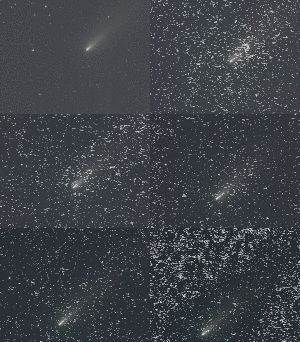 Comet Schwassmann Wachmann 3 Passes the Earth
23.05.2006
Rarely does a comet pass this close to Earth. Last week, dedicated astrofilmographers were able to take advantage of the close approach of crumbling 73P / Comet Schwassmann-Wachmann 3 to make time-lapse movies of the fast-moving comet. Large comet fragments passed about 25 times the Moon's distance from the Earth.
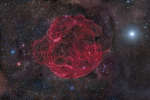 Simeis 147: Supernova Remnant
9.10.2012
It's easy to get lost following the intricate filaments in this detailed mosaic image of faint supernova remnant Simeis 147 (S147). Also cataloged as Sh2-240, it covers nearly 3 degrees or 6 full moons on the sky. That's about 150 light-years at the stellar debris cloud's estimated distance of 3,000 light-years.
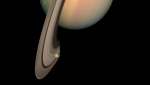 Cassini Approaches Saturn
19.04.2020
What would it look like to approach Saturn in a spaceship? One doesn't have to just imagine -- the Cassini spacecraft did just this in 2004, recording thousands of images along the way, and hundreds of thousands more since entering orbit.
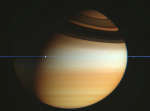 Cassini Spacecraft Crosses Saturn's Ring Plane
15.02.2010
If this is Saturn, where are the rings? When Saturn's "appendages" disappeared in 1612, Galileo did not understand why. Later that century, it became understood that Saturn's unusual protrusions were rings and that when the Earth crosses the ring plane, the edge-on rings will appear to disappear.
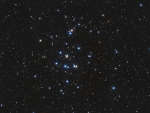 M44: The Beehive Cluster
22.02.2014
A mere 600 light-years away, M44 is one of the closest star clusters to our solar system. Also known as the Praesepe or the Beehive cluster its stars are young though, about 600 million years old compared to our Sun's 4.5 billion years.
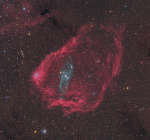 A Giant Squid in the Flying Bat
11.09.2015
Very faint but also very large on planet Earth's sky, a giant Squid Nebula cataloged as Ou4, and Sh2-129 also known as the Flying Bat Nebula, are both caught in this scene toward the royal constellation Cepheus.
 The Leo Trio
21.03.2025
This popular group leaps into the early evening sky around the March equinox and the northern hemisphere spring. Famous as the Leo Triplet, the three magnificent galaxies found in the prominent constellation Leo gather here in one astronomical field of view.
 Voyager's Preview of Galileo at Ganymede
27.06.1996
NASA's robot spacecraft Galileo began its long voyage to Jupiter in October of 1989. In December of last year it arrived in the Jovian system, beginning its unprecedented, detailed exploration by dropping a probe into the gas giant's atmosphere. By early this morning it will have accomplished another milestone in its ambitious mission.
 Jupiter in Infrared from Gemini
13.05.2020
In infrared, Jupiter lights up the night. Recently, astronomers at the Gemini North Observatory in Hawaii, USA, created some of the best infrared photos of Jupiter ever taken from EarthБs surface, pictured. Gemini...
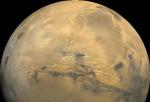 Mars: Just The Facts
27.06.1997
Mars, the freeze-dried planet, orbits 137 million miles from the Sun or at about 1.5 times the Earth-Sun distance. It has two diminutive moons, towering extinct volcanos, an immense canyon system, a thin atmosphere...
|
January February March April May June July August September October |
|||||||||||||||||||||||||||||||||||||||||||||||||