
|
You entered: Moon
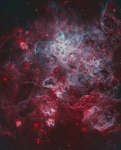 The Tarantula Zone
13.11.2020
The Tarantula Nebula, also known as 30 Doradus, is more than a thousand light-years in diameter, a giant star forming region within nearby satellite galaxy the Large Magellanic Cloud. About 180 thousand light-years away, it's the largest, most violent star forming region known in the whole Local Group of galaxies.
 APOD: 2023 November 21 Б Flemings Triangular Wisp
21.11.2023
These chaotic and tangled filaments of shocked, glowing gas are spread across planet Earth's sky toward the constellation of Cygnus as part of the Veil Nebula. The Veil Nebula itself is a large supernova remnant, an expanding cloud born of the death explosion of a massive star.
 APOD: 2025 November 16 Б Crossing Saturns Ring Plane
16.11.2025
If this is Saturn, where are the rings? When Saturn's "appendages" disappeared in 1612, Galileo did not understand why. Later that century, it became understood that Saturn's unusual protrusions were rings and that when the Earth crosses the ring plane, the edge-on rings will appear to disappear.
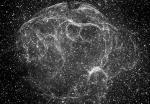 Simeis 147: Supernova Remnant
30.08.2002
It's easy to get lost following the intricate filaments in this stunningly detailed image of faint supernova remnant Simeis 147. Seen towards the constellation Taurus it covers nearly 3 degrees (6 full moons)...
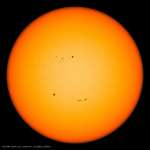 Live: Watching for Venus to Cross the Sun
5.06.2012
Today Venus moves in front of the Sun. One way to follow this rare event is to actively reload the above live image of the Sun during the right time interval and look for an unusual circular dark dot. The smaller sprawling dark areas are sunspots. The circular dot is the planet Venus.
 Highlights of the Summer Sky
27.06.2018
What can you see in the night sky this summer? The featured graphic gives a few highlights for Earth's northern hemisphere. Viewed as a clock face centered at the bottom, early (northern) summer sky events fan out toward the left, while late summer events are projected toward the right.
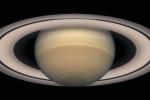 Saturn: Lord of the Rings
17.01.2004
Born in 1564, Galileo used a telescope to explore the Solar System. In 1610, he became the first to be amazed by Saturn's rings, After nearly 400 years, Saturn's magnificent rings still offer one of the most stunning astronomical sights.
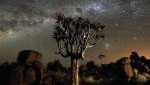 Namibian Nights
4.02.2013
Namibia has some of the darkest nights visible from any continent. It is therefore home to some of the more spectacular skyscapes, a few of which have been captured in the above time-lapse video.
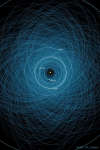 Orbits of Potentially Hazardous Asteroids
29.08.2021
Are asteroids dangerous? Some are, but the likelihood of a dangerous asteroid striking the Earth during any given year is low. Because some past mass extinction events have been linked to asteroid impacts, however, humanity has made it a priority to find and catalog those asteroids that may one day affect life on Earth.
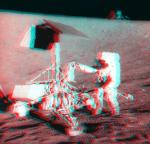 Apollo Surveyor Stereo View
10.03.2001
Put on your red/blue glasses and gaze into this dramatic stereo view from the surface of the Moon! Inspired by last Saturday's APOD, Patrick Vantuyne offers this stereo rendering of the captivating picture of Apollo 12 astronaut Pete Conrad visiting the Surveyor
|
January February March April May June July August September October |
|||||||||||||||||||||||||||||||||||||||||||||||||