
|
You entered: dust
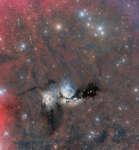 M78 Wide Field
21.01.2021
Interstellar dust clouds and glowing nebulae abound in the fertile constellation of Orion. One of the brightest, M78, is centered in this colorful, wide field view, covering an area north of Orion's belt. At a distance of about 1,500 light-years, the bluish reflection nebula is around 5 light-years across.
 IC 348 and Barnard 3
14.11.2024
A great nebulous region near bright star omicron Persei offers this study in cosmic contrasts. Captured in the telescopic frame the colorful complex of dust, gas, and stars spans about 3 degrees on the sky along the edge of the Perseus molecular cloud some 1000 light-years away.
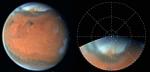 The Martian Spring
4.11.1996
As spring comes to the northern latitudes of Mars, increased solar heating brings warmth and a change in the weather. The winds produced by the large temperature differences between the receding polar...
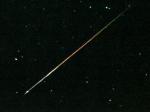 Rainbow Perseid
16.08.2002
While meteors do show colors, the colors aren't always seen with the unaided eye. Still, high speed color film recorded this rainbow-like trail as a meteor streaked through the early morning sky on August 13 above Sedona, Arizona, USA.
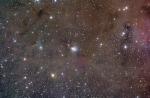 Stardust in Perseus
29.11.2007
This cosmic expanse of dust, gas, and stars covers some 4 degrees on the sky in the heroic constellation Perseus. Centered in the gorgeous skyscape is the dusty blue reflection nebula NGC 1333, about 1,000 light-years away. At that estimated distance, the field of view is nearly 70 light-years across.
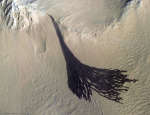 Dark Slope Streaks Split on Mars
18.07.2018
What is creating these dark streaks on Mars? No one is sure. Candidates include dust avalanches, evaporating dry ice sleds, and liquid water flows. What is clear is that the streaks occur through light surface dust and expose a deeper dark layer.
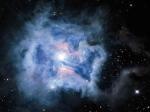 The Iris Nebula from CFHT
29.12.2005
Like delicate cosmic petals, these clouds of interstellar dust and gas have blossomed 1,300 light-years away in the fertile star fields of the constellation Cepheus. Sometimes called the Iris Nebula and dutifully cataloged as NGC 7023, this is not the only nebula in the sky to evoke the imagery of flowers.
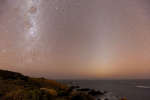 Zodiacal Light Over Laguna Verde
29.10.2009
An unusual triangle of light is visible this time of year just before dawn, in the northern hemisphere. Once considered a false dawn, this triangle of light is actually Zodiacal Light, light reflected from interplanetary dust particles.
 APOD: 2024 September 29 Б Seven Dusty Sisters
29.09.2024
Is this really the famous Pleiades star cluster? Known for its iconic blue stars, the Pleiades is shown here in infrared light where the surrounding dust outshines the stars. Here, three infrared colors have been mapped into visual colors (R=24, G=12, B=4.6 microns).
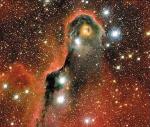 An Unusual Globule in IC 1396
19.10.2003
Is there a monster in IC 1396? Known to some as the Elephant's Trunk Nebula, parts of gas and dust clouds of this star formation region may appear to take on foreboding forms, some nearly human. The only real monster here, however, is a bright young star too far from Earth to hurt us.
|
January February March April May June July August September |
|||||||||||||||||||||||||||||||||||||||||||||||||