
|
You entered: Observatory
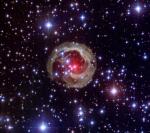 Startling Star V838 Mon
5.12.2003
Variable star V838 Monocerotis startled astronomers in January of 2002, undergoing a dramatic outburst like no other variable star known. Followed closely by ground-based instruments and the Hubble Space Telescope over the following months...
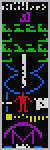 A Message from Earth
3.05.2020
What are these Earthlings trying to tell us? The featured message was broadcast from Earth towards the globular star cluster M13 in 1974. During the dedication of the Arecibo Observatory - still one of the largest single radio telescopes in the world - a string of 1's and 0's representing the diagram was sent.
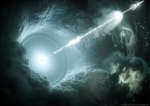 Neutrino Associated with Distant Blazar Jet
16.07.2018
With equipment frozen deep into ice beneath Earth's South Pole, humanity appears to have discovered a neutrino from far across the universe. If confirmed, this would mark the first clear detection of cosmologically-distant...
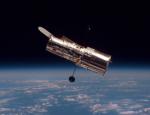 Hubble Floats Free
6.03.1997
Why put observatories in space? Most telescopes are on the ground. On the ground, you can deploy a heavier telescope and upgrade it more easily. The trouble is that Earth-bound telescopes must look through the Earth's atmosphere.
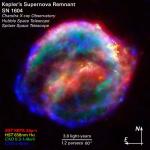 Kepler s SNR from Chandra, Hubble, Spitzer
8.10.2004
Light from the stellar explosion that created this energized cosmic cloud was first seen on planet Earth in October 1604, a mere four hundred years ago. The supernova produced a bright new star in early 17th century skies within the constellation Ophiucus.
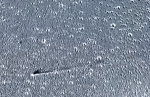 Comet Leonards Tail Wag
10.01.2022
Why does Comet Leonard's tail wag? The featured time-lapse video shows the ion tail of Comet C/2021 A1 (Leonard) as it changed over ten days early last month. The video was taken by NASA's Solar Terrestrial Relations Observatory-Ahead (STEREO-A) spacecraft that co-orbits the Sun at roughly the same distance as the Earth.
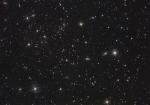 Time Tunnel
6.09.2007
Spiky stars are nearby, but fuzzy galaxies are strewn far across the Universe in this cosmic view. Spanning about 1/2 degree on the sky, the pretty picture is the result of astronomer Johannes Schedler's project to look back in time, toward a quasar 12.7 billion light-years away.
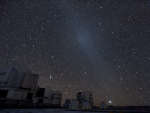 The Gegenschein Over Chile
7.05.2008
Is the night sky darkest in the direction opposite the Sun? No. In fact, a rarely discernable faint glow known as the gegenschein (German for "counter glow") can be seen 180 degrees around from the Sun in an extremely dark sky. The gegenschein is sunlight back-scattered off small interplanetary dust particles.
 Four X-class Flares
16.05.2013
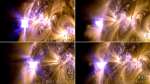
Swinging around the Sun's eastern limb on Monday, a group of sunspots labeled active region AR1748 has produced the first four X-class solar flares of 2013 in less than 48 hours. In time sequence clockwise from the top left, flashes from the four were captured in extreme ultraviolet images from the Solar Dynamics Observatory.
 LIGO Detects Gravitational Waves from Merging Black Holes
11.02.2016
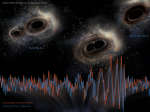
Gravitational radiation has been directly detected. The first-ever detection was made by both facilities of the Laser Interferometer Gravitational-Wave Observatory (LIGO) in Washington and Louisiana simultaneously last September. After numerous consistency checks, the resulting 5-sigma discovery was published today.
|
January February March April May June July August September October |
|||||||||||||||||||||||||||||||||||||||||||||||||