
|
You entered: Observatory
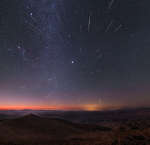 Geminid Meteors over Chile
23.12.2013
From a radiant point in the constellation of the Twins, the annual Geminid meteor shower rained down on planet Earth over the past few weeks. Recorded near the shower's peak over the night...
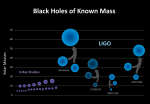 Black Holes of Known Mass
2.06.2017
Add GW170104 to the chart of black holes with known mass. The extremely energetic merger of two smaller black holes corresponds to the Laser Interferometer Gravitational-wave Observatory's (LIGO) third detection of gravitational waves.
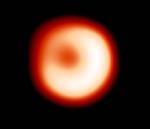 LkHa101: The Hole in the Doughnut
2.03.2001
You'd need a really big cup of coffee with this doughnut ... because the hole in the middle is about a billion kilometers across. Centered on the Sun, a circle that size would lie between the orbits of Mars and Jupiter.
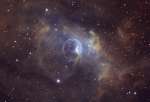 The Bubble Nebula
2.09.2010
Blown by the wind from a massive star, this interstellar apparition has a surprisingly familiar shape. Cataloged as NGC 7635, it is also known simply as The Bubble Nebula. Although it looks delicate, the 10 light-year diameter bubble offers evidence of violent processes at work.
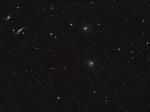 Stars, Galaxies, and Comet Tempel 1
12.05.2005
Faint comet Tempel 1 sports a fuzzy blue-tinted tail, just right of center in this lovely field of stars. Recorded on May 3rd slowly sweeping through the constellation Virgo, periodic comet Tempel 1 orbits the Sun once every 5.5 years.
 Markarians Chain of Galaxies
11.10.2006
Across the heart of the Virgo Cluster of Galaxies lies a striking string of galaxies known as Markarian's Chain. The chain, pictured above, is highlighted on the lower right with two large but featureless lenticular galaxies, M84 and M86, and connects through several large spiral to the upper left, including M88.
 XMM Launched
21.12.1999
X-ray astronomy entered a golden age earlier this month with the successful launch of the X-ray Multi-Mirror (XMM) satellite. XMM's three huge telescope barrels each hold 58 concentric cylindrical mirrors, together totaling a surface area rivaling a tennis court.
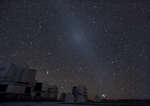 The Gegenschein Over Chile
2.12.2012
Is the night sky darkest in the direction opposite the Sun? No. In fact, a rarely discernable faint glow known as the gegenschein (German for "counter glow") can be seen 180 degrees around from the Sun in an extremely dark sky. The gegenschein is sunlight back-scattered off small interplanetary dust particles.
 Milky Way Rising
1.12.2023
The core of the Milky Way is rising beyond the Chilean mountain-top La Silla Observatory in this deep night skyscape. Seen toward the constellation Sagittarius, our home galaxy's center is flanked...
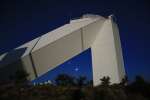 Bright Planets at McMath Pierce Solar Telescope
16.03.2012
Bright planets Venus and Jupiter are framed by the National Solar Observatory's McMath-Pierce Solar Telescope in this very astronomical scene. The photo was taken at Kitt Peak National Observatory on March 9.
|
January February March April May June July August September October |
|||||||||||||||||||||||||||||||||||||||||||||||||