
|
You entered: ring
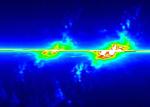 Streaming From A Black Hole
13.06.1997
Glowing gas clouds are streaming from the core of galaxy NGC4151 at hundreds of thousands of miles per hour. A powerful tool, the Hubble Space Telescope's new STIS instrument, makes it possible to map out the cloud velocities - producing this false color "velocity map" for the central regions of NGC4151.
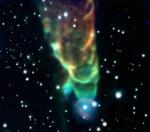 Cosmic Tornado HH 49 50
11.08.2007
Light-years in length, this cosmic tornado is actually a powerful jet cataloged as HH (Herbig-Haro) 49/50 blasting down from the top of a Spitzer Space Telescope view. Though such energetic outflows are well known...
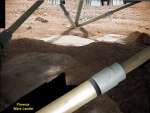 Phoenix and the Holy Cow
12.11.2008
The northern Martian summer is waning. As predicted, a decline in daylight hours, deteriorating weather, and dust storms are preventing solar arrays on the Phoenix Mars Lander from providing power. Phoenix's last signal...
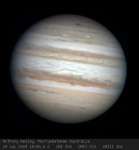 Jupiter s Impact Scar
23.07.2009
In July of 1994 pieces of Comet Shoemaker-Levy 9 collided with planet Jupiter. The explosive impacts sent plumes of debris high into the Jovian atmosphere creating dark markings or scars, visible for a time against the cloud bands.
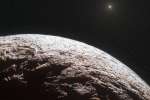 Makemake of the Outer Solar System
26.12.2012
Makemake is one of the largest objects known in the outer Solar System. Pronounced MAH-kay MAH-kay, this Kuiper belt object is about two-thirds the size of Pluto, orbits the Sun only slightly further out than Pluto, and appears only slightly dimmer than Pluto.
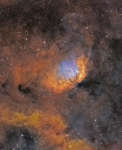 The Tulip in the Swan
14.11.2014
Framing a bright emission region this telescopic view looks out along the plane of our Milky Way Galaxy toward the nebula rich constellation Cygnus the Swan. Popularly called the Tulip Nebula the glowing cloud of interstellar gas and dust is also found in the 1959 catalog by astronomer Stewart Sharpless as Sh2-101.
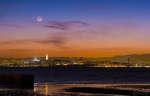 Mercury and Crescent Moon Set
15.04.2016
Innermost planet Mercury and a thin crescent Moon are never found far from the Sun in planet Earth's skies. Taken near dusk on April 8, this colorful evening skyscape shows them both setting toward the western horizon just after the Sun.
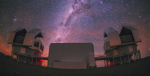 An Active Night over the Magellan Telescopes
21.02.2017
The night sky is always changing. Featured here are changes that occurred over a six hour period in late 2014 June behind the dual 6.5-meter Magellan Telescopes at Las Campanas Observatory in Chile.
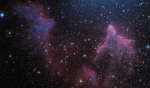 IC 59 and IC 63 in Cassiopeia
26.10.2018
These bright rims and flowing shapes look ghostly on a cosmic scale. A telescopic view toward the constellation Cassiopeia, the colorful (zoomable) skyscape features the swept-back, comet-shaped clouds IC 59 (left) and IC 63.
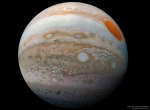 Jupiter Marble from Juno
8.05.2019
What does Jupiter look like up close? Most images of Jupiter are taken from far away, either from Earth or from a great enough distance that nearly half the planet is visible. This shot, though, was composed from images taken relatively close in, where less than half of the planet was visible.
|
January February March April May June July August |
||||||||||||||||||||||||||||||||||||||||||||||||||||||||