
|
You entered: ring
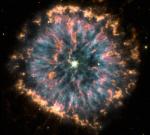 Celebrating Hubble With NGC 6751
7.04.2000
Planetary nebulae do look simple, round, and planet-like in small telescopes. But images from the orbiting Hubble Space Telescope have become well known for showing these fluorescent gas shrouds of dying Sun-like stars to possess a staggering variety of detailed symmetries and shapes.
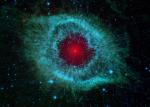 APOD: 2007 February 23- Dust and the Helix Nebula
23.02.2007
Dust makes this cosmic eye look red. The eerie Spitzer Space Telescope image shows infrared radiation from the well-studied Helix Nebula (NGC 7293) a mere 700 light-years away in the constellation Aquarius.
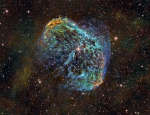 NGC 6888: The Crescent Nebula
16.08.2012
NGC 6888, also known as the Crescent Nebula, is a cosmic bubble about 25 light-years across, blown by winds from its central, bright, massive star. This colorful portrait of the nebula uses narrow band image data combined in the Hubble palatte.
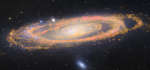 The Infrared Visible Andromeda
12.12.2014
This remarkable synthetic color composite image was assembled from archives of visible light and infrared astronomy image data. The field of view spans the Andromeda Galaxy (M31), a massive spiral a mere 2.5 million light-years away. In fact, with over twice the diameter of our own Milky Way, Andromeda is the largest nearby galaxy.
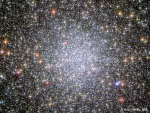 Globular Star Cluster 47 Tuc
19.05.2015
Globular star cluster 47 Tucanae is a jewel box of the southern sky. Also known as NGC 104, it roams the halo of our Milky Way Galaxy along with over 150 other globular star clusters.
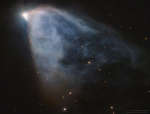 NGC 2261: Hubble s Variable Nebula
8.11.2017
What causes Hubble's Variable Nebula to vary? The unusual nebula featured here changes its appearance noticeably in just a few weeks. Discovered over 200 years ago and subsequently cataloged as NGC 2661, the remarkable nebula is named for Edwin Hubble, who studied it early last century.
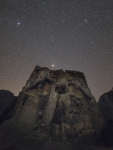 Mars, Pleiades, and Andromeda over Stone Lions
13.10.2020
Three very different -- and very famous -- objects were all captured in a single frame last month. On the upper left is the bright blue Pleiades, perhaps the most famous cluster of stars on the night sky. The Pleiades (M45) is about 450 light years away and easily found a few degrees from Orion.
 APOD: 2024 February 27 Б Supernova Remnant Simeis 147
27.02.2024
It's easy to get lost following the intricate, looping, and twisting filaments of supernova remnant Simeis 147. Also cataloged as Sharpless 2-240, the filamentary nebula goes by the popular nickname the Spaghetti Nebula.
 APOD: 2024 May 1 Б IC 1795: The Fishhead Nebula
1.05.2024
To some, this nebula looks like the head of a fish. However, this colorful cosmic portrait really features glowing gas and obscuring dust clouds in IC 1795, a star forming region in the northern constellation Cassiopeia.
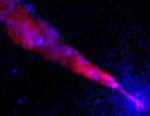 The Energetic Jet from Centaurus A
1.05.2003
The center of well-studied active galaxy Centaurus A is hidden from the view of optical telescopes by a cosmic jumble of stars, gas, and dust. But both radio and x-ray telescopes can trace the remarkable jet of high-energy particles streaming from the galaxy's core.
|
January February March April May June |
|||||||||||||||||||||||||||||||||||||||||||||||||