
|
You entered: dark
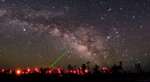 Messier Marathon
27.05.2011
In this action scene, red night vision lights, green laser pointers, tripods and telescopes in faint silhouette surround intrepid sky gazers embarked on the 10th annual Iran Messier Marathon. Completing the marathon requires viewing all 110 objects in 18th century French astronomer Charles Messier's catalog in one glorious dusk-to-dawn observing run.
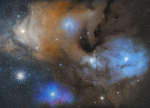 The Colorful Clouds of Rho Ophiuchi
3.12.2013
The many spectacular colors of the Rho Ophiuchi (oh'-fee-yu-kee) clouds highlight the many processes that occur there. The blue regions shine primarily by reflected light. Blue light from the star Rho Ophiuchi and nearby stars reflects more efficiently off this portion of the nebula than red light.
 APOD: 2023 May 23 Б Jupiters Swirls from Juno
23.05.2023
Big storms are different on Jupiter. On Earth, huge hurricanes and colossal cyclones are centered on regions of low pressure, but on Jupiter, it is the high-pressure, anti-cyclone storms that are the largest. On Earth, large storms can last weeks, but on Jupiter they can last years.
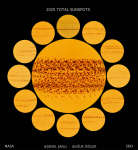 APOD: 2026 February 11 Б A Year of Sunspots
11.02.2026
How many sunspots can you see? The central image shows the many sunspots that occurred in 2025, month by month around the circle, and all together in the grand central image. Each sunspot is magnetically cooled and so appears dark -- and can last from days to months.
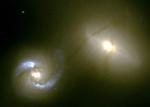 NGC 1410/1409: Intergalactic Pipeline
12.01.2001
These two galaxies are interacting in a surprising way, connected by a "pipeline" of obscuring material that runs between them over 20,000 light-years of intergalactic space. Silhouetted by starlight, the dark, dusty ribbon appears to stretch from NGC 1410 (the galaxy at the left) and wrap itself around NGC 1409 (at right).
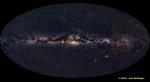 All-Sky Panorama
2.02.2001
This quite stunning panorama of the entire sky is a mosaic of 51 wide-angle photographs. Made over a three year period from locations in California (USA), South Africa, and Germany, the individual pictures were digitized and stitched together to create an apparently seamless 360 by 180 degree view.
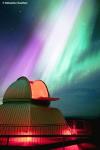 Mount Megantic Magnetic Storm
17.08.2000
Plasma from the Sun and debris from a comet both collided with planet Earth last Saturday morning triggering magnetic storms and a meteor shower in a dazzling atmospheric spectacle. The debris stream from comet...
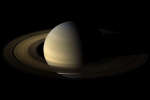 Saturn at Equinox
30.09.2009
How would Saturn look if its ring plane pointed right at the Sun? Before last month, nobody knew. Every 15 years, as seen from Earth, Saturn's rings point toward the Earth and appear to disappear.
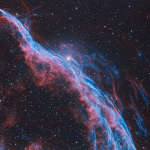 NGC 6960: The Witch s Broom Nebula
29.05.2013
Ten thousand years ago, before the dawn of recorded human history, a new light would have suddenly have appeared in the night sky and faded after a few weeks. Today we know this light was from a supernova, or exploding star, and record the expanding debris cloud as the Veil Nebula, a supernova remnant.
 NGC 6960: The Witchs Broom Nebula
8.04.2018
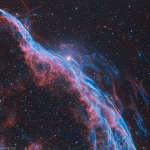
Ten thousand years ago, before the dawn of recorded human history, a new light would have suddenly have appeared in the night sky and faded after a few weeks. Today we know this light was from a supernova, or exploding star, and record the expanding debris cloud as the Veil Nebula, a supernova remnant.
|
January February March April May June July August September |
|||||||||||||||||||||||||||||||||||||||||||||||||