
|
You entered: dark
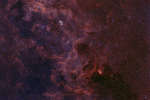 Cosmic Clouds in Cygnus
9.06.2022
These cosmic clouds of gas and dust drift through rich star fields along the plane of our Milky Way Galaxy toward the high flying constellation Cygnus. They're too faint to be seen with the unaided eye though, even on a clear, dark night.
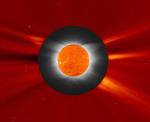 Solar Eclipse and SOHO
31.03.2006
Neither rain, nor snow, nor dark of night can keep the space-based SOlar Heliospheric Observatory (SOHO) from watching the Sun. In fact, from its vantage point 150 million kilometers sunward of planet Earth, SOHO's cameras can always monitor the Sun's outer atmosphere, or corona.
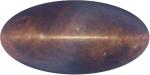 The Far Infrared Sky
17.05.2000
Three major sources contribute to the far-infrared sky: our Solar System, our Galaxy, and our Universe. The above recently released image, in representative colors, is the highest resolution projection yet created of the entire far-infrared sky (60 - 240 microns) created from years of observations by the now-defunct robot spacecraft COBE.
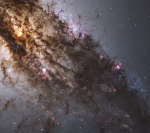 Across the Center of Centaurus A
29.11.2011
A fantastic jumble of young blue star clusters, gigantic glowing gas clouds, and imposing dark dust lanes surrounds the central region of the active galaxy Centaurus A. This image from the Hubble Space Telescope has been processed to present a natural color picture of this cosmic maelstrom.
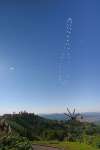 Austrian Analemma
22.09.2012
Today, the Sun crosses the celestial equator heading south at 14:49 Universal Time. An equinox (equal night), this astronomical event marks the first day of autumn in the northern hemisphere and spring in the south.
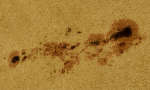 Large Sunspots Now Crossing the Sun
10.07.2013
One of the largest sunspot regions in recent years is now crossing the Sun. This region of convoluted magnetic fields may well produce a solar flare that releases a cloud of energetic particles into the Solar System.
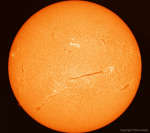 An Extremely Long Filament on the Sun
9.02.2015
Yesterday, the Sun exhibited one of the longest filaments ever recorded. It may still be there today. Visible as the dark streak just below the center in the featured image, the enormous filament extended across the face of the Sun a distance even longer than the Sun's radius -- over 700,000 kilometers.
 In the Center of the Trifid Nebula
11.10.2015
Clouds of glowing gas mingle with dust lanes in the Trifid Nebula, a star forming region toward the constellation of the Archer (Sagittarius). In the center, the three prominent dust lanes that give the Trifid its name all come together.
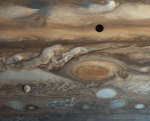 Europa and Jupiter from Voyager 1
5.09.2017
What are those spots on Jupiter? Largest and furthest, just right of center, is the Great Red Spot -- a huge storm system that has been raging on Jupiter possibly since Giovanni Cassini's likely notation of it 352 years ago. It is not yet known why this Great Spot is red.
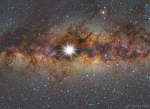 Solstice Sun and Milky Way
21.12.2021
Welcome to December's solstice, first day of winter in the north and summer for the southern hemisphere. Astronomical markers of the seasons, solstice and equinox dates are based on the Sun's place in its annual journey along the ecliptic, through planet Earth's sky.
|
January February March April May June July August September |
|||||||||||||||||||||||||||||||||||||||||||||||||