
|
You entered: planet
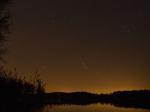 A Leonid Meteor Over Sweden
21.11.2006
This past weekend, small remnant bits of a distant comet lit up the skies over much of planet Earth. Incoming reports, however, have this year's Leonid meteor shower as less active than Leonid meteor showers a few years ago.
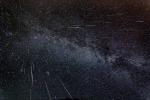 Raining Perseids
12.08.2007
Tonight is a good night to see meteors. Comet dust will rain down on planet Earth, streaking through dark skies in the annual Perseid meteor shower. While enjoying the anticipated space weather, astronomer Fred...
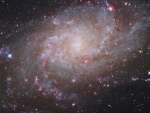 M33: Triangulum Galaxy
13.09.2008
The small, northern constellation Triangulum harbors this magnificent face-on spiral galaxy, M33. Its popular names include the Pinwheel Galaxy or just the Triangulum Galaxy. M33 is over 50,000 light-years in diameter, third largest in the Local Group of galaxies after the Andromeda Galaxy (M31), and our own Milky Way.
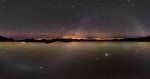 A Tale of Two Hemispheres
30.07.2011
A quest to find planet Earth's darkest night skies led to this intriguing panorama. In projection, the mosaic view sandwiches the horizons visible in all-sky images taken from the northern hemisphere's Canary Island of La Palma (top) and the south's high Atacama Desert between the two hemispheres of the Milky Way Galaxy.
 Barnard Stares at NGC 2170
19.01.2013
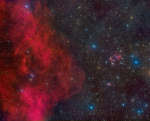
A gaze across a cosmic skyscape, this telescopic mosaic reveals the continuous beauty of things that are. The evocative scene spans some 6 degrees or 12 Full Moons in planet Earth's sky. At the left, folds of red, glowing gas are a small part of an immense, 300 light-year wide arc.
 Messier 109
23.05.2013
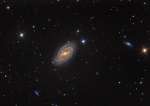
Beautiful barred spiral galaxy M109, 109th entry in Charles Messier's famous catalog of bright Nebulae and Star Clusters, is found just below the Big Dipper's bowl in the northern constellation Ursa Major.
 Night in the Andes Ice Forest
7.09.2013
This forest of snow and ice penitentes reflects moonlight shinning across the Chajnantor plateau. The region lies in the Chilean Andes at an altitude of 5,000 meters, not far from one of planet Earth's major astronomical observatories, the Atacama Large Millimeter/submillimeter Array.
 Cassinis Grand Finale Tour at Saturn
25.01.2017
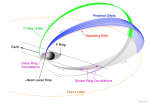
Cassini is being prepared to dive into Saturn. The robotic spacecraft that has been orbiting and exploring Saturn for over a decade will end its mission in September with a spectacular atmospheric plunge. Pictured here is a diagram of Cassini's remaining orbits, each taking about one week.
 North America and the Pelican
1.12.2017
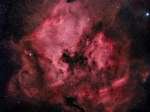
Fans of our fair planet might recognize the outlines of these cosmic clouds. On the left, bright emission outlined by dark, obscuring dust lanes seems to trace a continental shape, lending the popular name North America Nebula to the emission region cataloged as NGC 7000.
 A Harvest Moon
13.09.2019
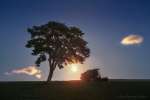
Famed in festival, story, and song the best known full moon is the Harvest Moon. For northern hemisphere dwellers that's a traditional name of the closest full moon to the September equinox. In most North America time zones this year's Harvest Moon will officially rise on Friday, September 13.
|
January February March April May June July August September |
|||||||||||||||||||||||||||||||||||||||||||||||||