
|
You entered: planet
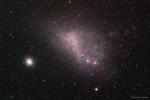 APOD: 2007 October 1- The Small Cloud of Magellan
1.10.2007
Portuguese navigator Ferdinand Magellan and his crew had plenty of time to study the southern sky during the first circumnavigation of planet Earth. As a result, two celestial wonders easily visible for southern hemisphere skygazers are known as the Clouds of Magellan.
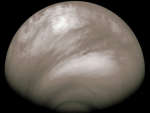 Mysterious Acid Haze on Venus
26.02.2008
Why did an acidic haze spread across Venus? The unusual clouds were discovered last July by ESA's robotic Venus Express spacecraft currently orbiting Venus. The bright and smooth haze was found by Venus...
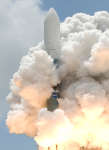 At Last GLAST
11.06.2018
Rising through a billowing cloud of smoke, a long time ago from a planet very very close by, this Delta II rocket left Cape Canaveral Air Force Station's launch pad 17-B at 12:05 pm EDT on June 11, 2008. Snug in the payload section was GLAST, the Gamma-ray Large Area Space Telescope.
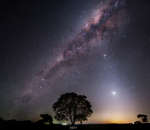 A Light and Dusty Night
2.10.2021
Posing as a brilliant evening star, Venus lies near the western horizon in this southern hemisphere, early spring, night skyscape. To create the composite view exposures tracking the sky and fixed for the foreground were taken on September 25 from Cascavel in southern Brazil.
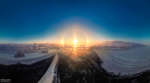 Sun Halo at Sixty three Degrees North
21.12.2022
Happy Solstice! Today is the December solstice, marking an astronomical beginning of summer in the southern hemisphere and winter in the north. On its yearly trek through planet Earth's skies, at this solstice the Sun reaches its southern most declination, 23.5 degrees south, at 21:48 UTC.
 Most of Comet Tsuchinshan ATLAS
18.10.2024
On October 14 it was hard to capture a full view of Comet C/2023 A3 Tsuchinshan-ATLAS. Taken after the comet's closest approach to our fair planet, this evening skyview almost does though. With...
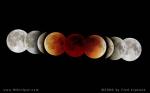 Third Millennium, First Eclipse
4.01.2001
The first eclipse of the third millennium is coming up! A total lunar eclipse mainly visible from Europe, Asia, and Africa, will occur on January 9th as the full Moon glides through the long, but not so dark shadow of planet Earth. Why not so dark?
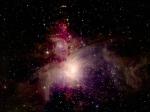 Orion Nebula: The 2MASS View
20.04.2002
Few astronomical sights excite the imagination like the nearby stellar nursery known as the Orion Nebula. The Nebula's glowing gas surrounds hot young stars at the edge of an immense interstellar molecular cloud only 1,500 light-years away.
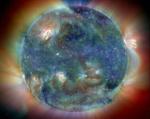 Solstice Celebration
21.12.2002
Aloha and Season's greetings! On December 22nd, at 01:14 Universal Time (December 21, 3:14pm Hawaii-Aleutian Standard Time), the Sun reaches its southernmost point in planet Earth's sky marking the final season change for the year 2002. In celebration, consider this delightfully detailed, brightly colored image of the active Sun.
 Moon Slide Slim
15.05.2003
No special filters - or even a telescope - are required to enjoy a leisurely lunar eclipse. In fact, watched from all over the night side of planet Earth, these regular celestial performances have entertained many casual skygazers. Still, this eye-catching picture of a lunar eclipse may look unfamiliar.
|
January February March April May June July August September |
|||||||||||||||||||||||||||||||||||||||||||||||||