
|
You entered: Earth
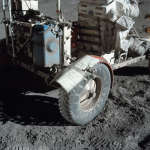 Lunar Dust and Duct Tape
29.05.2021
Why is the Moon so dusty? On Earth, rocks are weathered by wind and water, creating soil and sand. On the Moon, the history of constant micrometeorite bombardment has blasted away at the rocky surface creating a layer of powdery lunar soil or regolith.
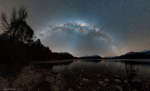 Galaxy by the Lake
10.09.2022
This 180 degree panoramic night skyscape captures our Milky Way Galaxy as it arcs above the horizon on a winter's night in August. Near midnight, the galactic center is close to the zenith with the clear waters of Lake Traful, Neuquen, Argentina, South America, planet Earth below.
 Comet Pons-Brooks at Night
4.04.2024
In dark evening skies over June Lake, northern hemisphere, planet Earth, Comet 12P/Pons-Brooks stood just above the western horizon on March 30. Its twisted turbulent ion tail and diffuse greenish coma are captured in this two degree wide telescopic field of view along with bright yellowish star Hamal also known as Alpha Arietis.
 APOD: 2024 July 31 Б Leopard Spots on Martian Rocks
31.07.2024
What is creating these unusual spots? Light-colored spots on Martian rocks, each surrounded by a dark border, were discovered earlier this month by NASA's Perseverance Rover currently exploring Mars. Dubbed leopard spots because...
 APOD: 2025 September 2 Б The Horsehead and Flame Nebulas
2.09.2025
The Horsehead Nebula is one of the most famous nebulae on the sky. It is visible as the dark indentation to the orange emission nebula at the far right of the featured picture. The horse-head feature is dark because it is really an opaque dust cloud that lies in front of the bright emission nebula.
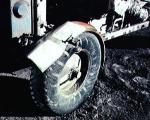 Lunar Dust and Duct Tape
1.05.1999
Why is the Moon dusty? On Earth, rocks are weathered by wind and water, creating soil and sand. On the Moon, the long history of micrometeorite bombardment has blasted away at the rocky surface creating a layer of powdery lunar soil or regolith. This lunar regolith could be a scientific and industrial bonanza.
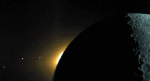 The Ecliptic Plane
14.10.2000
The Plane of the Ecliptic is well illustrated in this picture from the 1994 lunar prospecting Clementine spacecraft. Clementine's star tracker camera image reveals (from right to left) the Moon lit by Earthshine, the Sun's corona rising over the Moon's dark limb, and the planets Saturn, Mars, and Mercury.
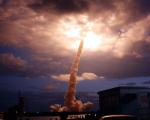 Columbia Dawn
8.03.2002
Trailing a thick column of exhaust, the Space Shuttle Columbia blasted into the twilight morning sky on March 1, its thundering rockets briefly flooding a cloud bank with the light of a false dawn. The event marked the start of the ongoing eleven day mission to upgrade the Hubble Space Telescope.
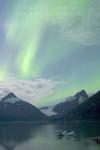 Aurora Over the Chugach Mountains
29.09.2003
Auroras can make spectacular sights. Photographed above, flowing green auroras help the Moon illuminate the serene Portage Lake and the snowy Chugach Mountains near Anchorage, Alaska, USA. Although auroras might first appear to be moonlit clouds, they only add light to the sky and do not block background stars from view.
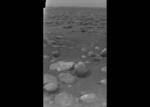 Huygens Images Titan s Surface
15.01.2005
After a seven year interplanetary voyage on board the the Cassini spacecraft, the European Space Agency's Huygens probe parachuted to a historic landing on Saturn's moon Titan on January 14. Above...
|
January February |
|||||||||||||||||||||||||||||||||||||||||||||||||