
|
You entered: Earth
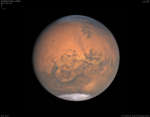 Close Mars
31.08.2018
Still bright in evening skies, Mars was just past opposition and closest to Earth on July 31, a mere 57.6 million kilometers away. Captured only a week later, this remarkable image shows...
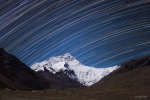 Mount Everest Star Trails
1.12.2018
The highest peak on planet Earth is framed in this mountain and night skyscape. On September 30, the digital stack of 240 sequential exposures made with a camera fixed to a tripod at an Everest Base Camp captured the sheer north face of the Himalayan mountain and foreground illuminated by bright moonlight.
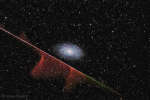 Meteor Misses Galaxy
30.04.2019
The galaxy was never in danger. For one thing, the Triangulum galaxy (M33), pictured, is much bigger than the tiny grain of rock at the head of the meteor. For another, the galaxy is much farther away -- in this instance 3 million light years as opposed to only about 0.0003 light seconds.
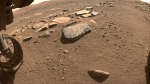 Mars Rock Rochette
28.08.2021
Taken on mission sol 180 (August 22) this sharp image from a Hazard Camera on the Perseverance rover looks out across a rock strewn floor of Jezero crater on Mars. At 52.5 centimeters (21 inches) in diameter, one of the rover's steerable front wheels is at lower left in the frame.
 Messier 4
29.11.2024
Messier 4 can be found west of bright red-giant star Antares, alpha star of the constellation Scorpius. M4 itself is only just visible from dark sky locations, even though the globular cluster of 100,000 stars or so is a mere 5,500 light-years away.
 Many Moons
5.07.2002
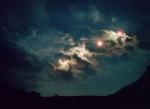
Whimsical and creative, this multiple exposure suggests that planet Earth's sky could be very dramatic indeed if it were graced by many moons. And in James Thurber's well-known children's story, Princess...
 Jupiter, Moons, and Bees
25.09.2002
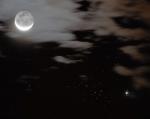
Rising before the Sun on September 4, Jupiter and an old cresent Moon gathered in the dim constellation of Cancer. Watching from a hillside near Austin, Texas, planet Earth, astrophotographer Russell Croman recorded this view of their passing as clouds gracefully dimmed the brilliant moonlight.
 Europa's Surface
13.08.1996
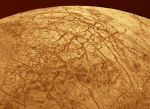
Voyager spacecraft images of Europa's surface, like the one above, are suggestive of sea ice on Earth. The criss-crossing dark streaks may indeed be cracks in its ice-covered surface caused by Jupiter's tidal stresses accompanied by the freezing and expansion of an underlying layer of water.
 Red Sun Streaming
7.01.1997
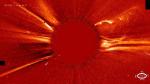
The Sun is leaking. In fact, it is gushing: particles stream away from the Sun at hundreds of kilometers per second. Some of these particles strike the Earth and cause aurora. Most particles, however, either surround the Sun as a huge solar corona or glide into interstellar space as the solar wind.
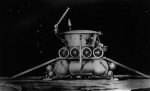 Moon Robot: Lunokhod 1
20.04.1997
On November 17, 1970 the Soviet Luna 17 spacecraft landed the first roving remote-controlled robot on the Moon. Known as Lunokhod 1, it weighed just under 2,000 pounds and was designed to operate for 90 days guided by a 5-person team at the Deep Space Center near Moscow, USSR, Planet Earth.
|
January February |
|||||||||||||||||||||||||||||||||||||||||||||||||