
|
You entered: loops
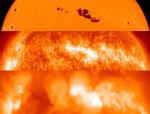 Sunspot Stack
19.04.2001
Welcome to multiwavelength astronomy! From top to bottom, these stacked panels show the largest sunspot group in a decade in visible, extreme ultraviolet, and x-ray light. All were taken on March 29, around...
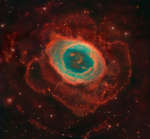 M57: The Ring Nebula
20.04.2012
Except for the rings of Saturn, the Ring Nebula (M57) is probably the most famous celestial band. Its classic appearance is understood to be due to perspective - our view from planet Earth looks down the center of a roughly barrel-shaped cloud of glowing gas.
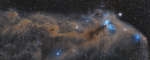 Across Corona Australis
29.11.2018
Cosmic dust clouds are draped across a rich field of stars in this broad telescopic panorama near the northern boundary of Corona Australis, the Southern Crown. Less than 500 light-years away the denser clouds effectively block light from more distant background stars in the Milky Way.
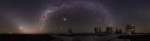 Wonder and Mystery above the Very Large Telescopes
9.05.2011
What's that bright orange dot above the large telescope on the right? Even seasoned sky enthusiasts might ponder the origin of the orange orb seen by scrolling across this panoramic image, taken last December. Perhaps identifying known objects will help.
 Stars and Dust across Corona Australis
22.06.2023
Cosmic dust clouds cross a rich field of stars in this telescopic vista near the northern boundary of Corona Australis, the Southern Crown. Part of a sprawling molecular cloud complex this star forming region is a mere 500 light-years away.
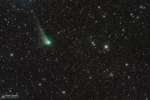 Two Comets in Southern Skies
8.10.2022
Heading for its closest approach to the Sun or perihelion on December 20, comet C/2017 K2 (PanSTARRS) remains a sight for telescopic observers as it sweeps through planet Earth's southern hemisphere skies. First...
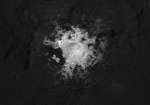 Cerealia Facula
19.07.2018
Cerealia Facula, also known as the brightest spot on Ceres, is shown in this stunning mosaic close-up view. The high-resolution image data was recorded by the Dawn spacecraft, in a looping orbit, from altitudes as low as 34 kilometers (21 miles) above the dwarf planet's surface.
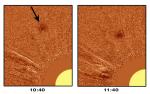 Coronal Inflow
29.11.2001
The active Sun has thrown a lot our way lately, including storms of particles streaming outward in the solar wind and clouds of plasma which triggered awesome auroral displays. Still, a growing body...
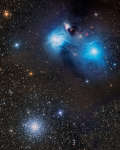 Stars and Dust Across Corona Australis
6.08.2021
Cosmic dust clouds cross a rich field of stars in this telescopic vista near the northern boundary of Corona Australis, the Southern Crown. Less than 500 light-years away the dust clouds effectively block light from more distant background stars in the Milky Way.
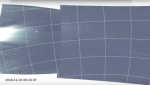 Looking Sideways from the Parker Solar Probe
9.12.2019
Everybody sees the Sun. Nobody's been there. Starting in 2018 though, NASA launched the robotic Parker Solar Probe (PSP) to investigate regions near to the Sun for the first time. The PSP's looping orbit brings it yet closer to the Sun each time around -- every few months.
|
January February March April May June July August September |
|||||||||||||||||||||||||||||||||||||||||||||||||