
|
You entered: loops
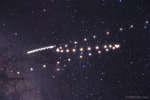 Retrograde Mars and Saturn
15.09.2016
Wandering Mars and Saturn have spent much of this year remarkably close in planet Earth's night sky. In a sequence of exposures spanning mid-December 2015 through the beginning of this week, this composited...
 Mars, Ceres, Vesta
10.04.2014
That bright, ruddy star you've recently noticed rising just after sunset isn't a star at all. That's Mars, the Red Planet. Mars is now near its 2014 opposition (April 8) and closest approach (April 14), looping through the constellation Virgo opposite the Sun in planet Earth's sky.
 APOD: 2024 May 8 Б Visualization: A Black Hole Accretion Disk
8.05.2024
What would it look like to circle a black hole? If the black hole was surrounded by a swirling disk of glowing and accreting gas, then the great gravity of the black hole would deflect light emitted by the disk to make it look very unusual. The featured animated video gives a visualization.
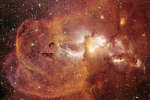 Star Forming Region NGC 3582
28.04.2008
What's happening in the NGC 3582 nebula? Bright stars and interesting molecules are forming. The complex nebula resides in the star forming region called RCW 57. Visible in this image are dense knots...
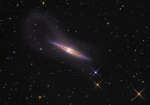 NGC 4013 and the Tidal Stream
7.02.2008
Nearly 50 million light-years away in the constellation Ursa Major, NGC 4013 was long considered an isolated island universe. Seen edge-on, the gorgeous spiral galaxy was known for its flattened disk and central bulge of stars, cut by silhouetted dust lanes.
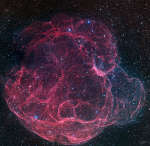 Simeis 147: Supernova Remnant
21.11.2019
It's easy to get lost following the intricate looping filaments in this detailed image of supernova remnant Simeis 147. Also cataloged as Sharpless 2-240 it goes by the popular nickname, the Spaghetti Nebula.
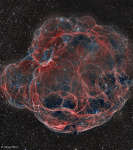 Simeis 147: Supernova Remnant
10.12.2020
It's easy to get lost following the intricate looping filaments in this detailed image of supernova remnant Simeis 147. Also cataloged as Sharpless 2-240 it goes by the popular nickname, the Spaghetti Nebula.
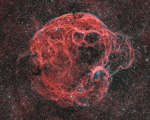 Supernova Remnant Simeis 147
13.01.2022
It's easy to get lost following the intricate, looping, twisting filaments in this detailed image of supernova remnant Simeis 147. Also cataloged as Sharpless 2-240 it goes by the popular nickname, the Spaghetti Nebula.
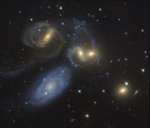 Stephan s Quintet
25.02.2012
The first identified compact galaxy group, Stephan's Quintet is featured in this eye-catching image constructed with data drawn from the extensive Hubble Legacy Archive. About 300 million light-years away, only four of these five galaxies are actually locked in a cosmic dance of repeated close encounters.
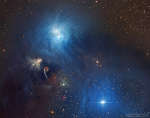 Stars and Dust in Corona Australis
12.01.2020
Cosmic dust clouds and young, energetic stars inhabit this telescopic vista, less than 500 light-years away toward the northern boundary of Corona Australis, the Southern Crown. The dust clouds effectively block light from more distant background stars in the Milky Way.
|
January February March April May June July August September |
|||||||||||||||||||||||||||||||||||||||||||||||||