
|
You entered: outer Galaxy
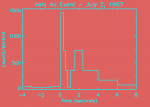 Gamma Ray Burst: A Milestone Explosion
2.07.2000
Gamma-Ray Bursts (GRBs) were discovered by accident. Thirty three years ago today, satellites first recorded a GRB. The data plotted here show that the count rate of the satellite gamma-ray instrument abruptly jumped indicating a sudden flash of gamma-rays.
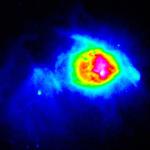 Hydrogen Blob N88A in the Small Magellanic Cloud
29.07.1999
The bright blob of hydrogen gas cataloged as N88A is seen at the right. It measures a mere 3 light years across. Emerging from the cool, dusty interstellar medium in a nearby irregular galaxy known as the Small Magellanic Cloud, N88A hides hot young stars at its core.
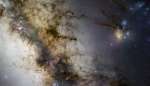 Gigagalaxy Zoom: Galactic Center
25.09.2009
From Sagittarius to Scorpius, the central Milky Way is a truly beautiful part of planet Earth's night sky. The gorgeous region is captured here, an expansive gigapixel mosaic of 52 fields spanning 34 by 20 degrees in 1200 individual images and 200 hours of exposure time.
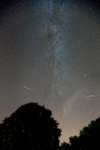 Night of the Perseids
14.08.2010
On the night of August 12, from moonset until dawn was a good time to see meteors. Enthusiasts watched as comet dust rained on planet Earth, streaking through dark skies during the annual Perseid Meteor Shower.
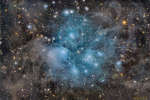 The Pleiades Deep and Dusty
25.02.2014
The well known Pleiades star cluster is slowly destroying part of a passing cloud of gas and dust. The Pleiades is the brightest open cluster of stars on Earth's sky and can be seen from almost any northerly location with the unaided eye.
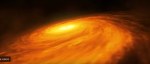 Animation: Spiral Disk around a Black Hole
20.08.2019
What would it look like to orbit a black hole? Many black holes are surrounded by swirling pools of gas known as accretion disks. These disks can be extremely hot, and much of the orbiting gas will eventually fall through the black hole's event horizon -- where it will never been seen again.
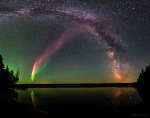 A Glowing STEVE and the Milky Way
17.11.2020
What's creating these long glowing streaks in the sky? No one is sure. Known as Strong Thermal Emission Velocity Enhancements (STEVEs), these luminous light-purple sky ribbons may resemble regular auroras, but recent research reveals significant differences.
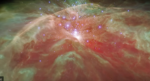 Flight Through the Orion Nebula in Infrared Light
7.07.2021
What would it look like to fly into the Orion Nebula? The exciting dynamic visualization of the Orion Nebula is based on real astronomical data and adept movie rendering techniques. Up close and personal...
 APOD: 2024 September 23 Б Comet Tsuchinshan ATLAS Approaches
23.09.2024
What will happen as this already bright comet approaches? Optimistic predictions have Comet C/2023 A3 (TsuchinshanБATLAS) briefly becoming easily visible to the unaided eye -- although the future brightness of comets are notoriously hard to predict, and this comet may even break up in warming sunlight.
 Too Close to a Black Hole
5.01.1997
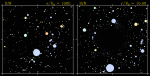
What would you see if you went right up to a black hole? Above are two computer generated pictures highlighting how strange things would look. On the left is a normal star field containing the constellation Orion. Notice the three stars of nearly equal brightness that make up Orion's Belt.
|
January February March April May June July August September |
|||||||||||||||||||||||||||||||||||||||||||||||||