
|
You entered: galaxies
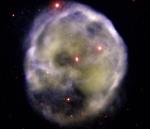 NGC 246 and the Dying Star
18.04.2006
Appropriately nicknamed "the Skull Nebula", planetary nebula NGC 246 really does surround a dying star some 1,600 light-years away in the constellation Cetus. Expelled over a period of thousands of years, the lovely, intricate nebula is the outer atmosphere of a once sun-like star.
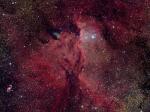 Reflections on NGC 6188
1.06.2006
NGC 6188 is an interstellar carnival of young blue stars, hot red gas, and cool dark dust. Located 4,000 light years away in the disk of our Galaxy, NGC 6188 is home to the Ara OB1 association, a group of bright young stars whose nucleus forms the open cluster NGC 6193.
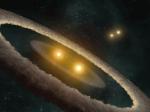 The Four Suns of HD 98800
30.07.2007
How would it look to have four suns in the sky? Planets of the HD 98800 system, if they exist, would experience such a view. HD 98800 is a multiple star system about 150 light years from Earth -- right in our section of the Milky Way Galaxy.
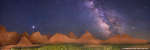 The Milky Way Over the Badlands
18.08.2009
Why take a picture of just the Badlands when you can take one that also shows the spectacular sky above it? Just such a picture, actually a digital stitched panorama of four images, was taken in late June near midnight, looking southwest.
 Deep Auriga
5.03.2010
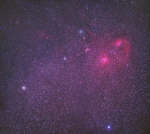
The plane of our Milky Way Galaxy runs right through Auriga, the Charioteer. A good part of the ancient northern constellation's rich collection of nebulae and star clusters is featured in this expansive, 10 degree wide skyscape. Bright star Elnath lies near the bottom right, linking Auriga to another constellation, Taurus, the Bull.
 Simeis 188 in Stars, Dust and Gas
27.06.2012
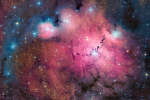
When stars form, pandemonium reigns. A particularly colorful case is the star forming region Simeis 188 which houses an unusual and bright cloud arc cataloged as NGC 6559. Visible above are red glowing emission nebulas of hydrogen, blue reflection nebulas of dust, dark absorption nebulas of dust, and the stars that formed from them.
 APOD: 2024 July 21 Б King of Wings Hoodoo under the Milky Way
21.07.2024
This rock structure is not only surreal -- it's real. Perhaps the reason it's not more famous is that it is smaller than one might guess: the capstone rock overhangs only a few meters.
 APOD: 2026 May 14 Б The Messier Catalog at Uniform Scale
14.05.2026
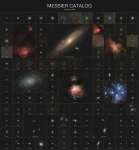
What are some of the most interesting astronomical objects you can see in the night sky? Armed with a good pair of binoculars or a small telescope, if you live in the Northern Hemisphere, you can look for the very popular objects in the Messier Catalog.
 Watch the Sky Rotate
10.01.2001
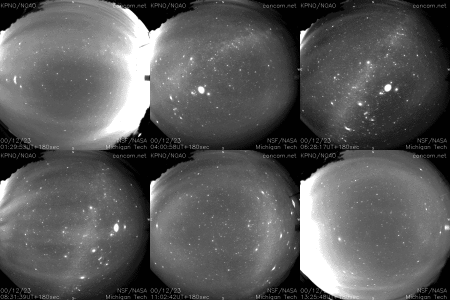
If you could watch the sky for an entire night, what would you see? The above time-lapse sequence from the CONtinuous CAMera (CONCAM) project shows the answer for the skies above Kitt Peak National Observatory on 2000 December 23.
 Happy Birthday Charles Messier: M1
26.06.1996
French astronomer Charles Messier was born on June 26, 1730. Inspired by childhood sightings of comets and a solar eclipse visible from his home town of Badonvillier, he became an astronomer and comet hunter who kept careful records of his observations.
|
January February March April May |
|||||||||||||||||||||||||||||||||||||||||||||||||