
|
You entered: galaxies
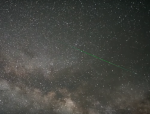 Night of the Perseids
28.09.2021
Have you ever experienced a meteor shower? To help capture the wonder, a video was taken during the peak of the recent Perseid meteor shower above the Indian Astronomical Observatory in Hanle, India, high up in the Himalayan mountains.
 APOD: 2025 September 19 Б The NGC 6914 Complex
19.09.2025
A study in contrasts, this colorful cosmic skyscape features stars, dust, and glowing gas in the vicinity of NGC 6914. The interstellar complex of nebulae lies some 6,000 light-years away, toward the high-flying northern constellation Cygnus and the plane of our Milky Way Galaxy.
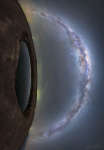 APOD: 2026 April 19 Б Eye on the Milky Way
19.04.2026
Have you ever had stars in your eyes? It appears that the eye on the left does, and moreover, it appears to be gazing at even more stars. The featured 27-frame mosaic was taken in 2019 from Ojas de Salar in the Atacama Desert of Chile.
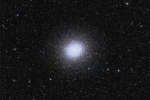 Omega Centauri: The Largest Globular Cluster Known
1.03.2009
This huge ball of stars predates our Sun. Long before humankind evolved, before dinosaurs roamed, and even before our Earth existed, ancient globs of stars condensed and orbited a young Milky Way Galaxy. Of the 200 or so globular clusters that survive today, Omega Centauri is the largest, containing over ten million stars.
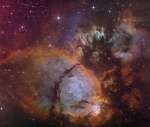 The Colors of IC 1795
10.12.2009
This colorful cosmic portrait features glowing gas and dark dust clouds in IC 1795, a star forming region in the northern constellation Cassiopeia. The nebula's colors were created by adopting the Hubble false-color...
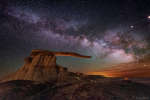 King of Wings Hoodoo under the Milky Way
28.03.2017
This rock structure is not only surreal -- it's real. The reason it's not more famous is that it is, perhaps, smaller than one might guess: the capstone rock overhangs only a few meters.
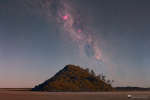 Carina over Lake Ballard
5.01.2018
A jewel of the southern sky, the Great Carina Nebula, also known as NGC 3372, is one of our galaxy's largest star forming regions. Easily visible to the unaided eye it stands high...
 APOD: 2025 August 3 Б Milky Way and Exploding Meteor
3.08.2025
In about a week the Perseid Meteor Shower will reach its maximum. Grains of icy rock will streak across the sky as they evaporate during entry into Earth's atmosphere. These grains were shed from Comet Swift-Tuttle.
 At the Core of M15
20.11.1995
Densely packed stars in the core of the globular cluster M15 are shown in this Hubble Space Telescope (HST) image taken in April of 1994. The stars revealed are contained in an area 1.6 light years across and their colors roughly indicate their temperatures - hot stars appear blue, cooler stars look reddish-orange.
 Orion Nebula in Oxygen, Hydrogen, and Sulfur
13.07.2004
The Great Nebula in Orion, an immense, nearby starbirth region, is arguably the most famous of all astronomical nebulae. The Orion Nebula, also known as M42, is shown above through ultraviolet and blue filters augmented with three exact colors specifically emitted by hydrogen, oxygen, and sulfur.
|
January February March April May |
|||||||||||||||||||||||||||||||||||||||||||||||||