
|
You entered: Sun
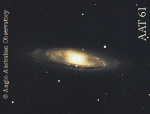 Leo Triplet Spiral Galaxy M65
12.08.1996
Spiral galaxy M65 is a normal spiral galaxy not unlike our own Milky Way. In fact, M65 is a typical spiral galaxy of a type that could be found anywhere in the local universe. Given a morphological type of "Sa", M65 shows tightly wrapped spiral arms and a large nuclear central bulge.
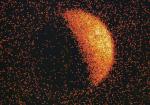 X-Ray Moon
4.10.2003
This x-ray image of the Moon was made by the orbiting ROSAT (Röntgensatellit) Observatory in 1990. In this digital picture, pixel brightness corresponds to x-ray intensity. Consider the image in three parts: the bright hemisphere of the x-ray moon, the darker half of the moon, and the x-ray sky background.
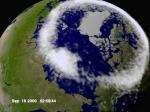 A Proton Aurora
17.12.2003
What are auroras made out of? Most auroras are caused by the solar wind exciting electrons that are funneled down the Earth's magnetic field. These electrons strike air molecules, liberating other electrons that glow when re-acquired.
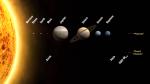 Eight Planets and New Solar System Designations
28.08.2006
How many planets are in the Solar System? This popular question now has a new formal answer according the International Astronomical Union (IAU): eight. Last week, the IAU voted on a new definition for planet and Pluto did not make the cut.
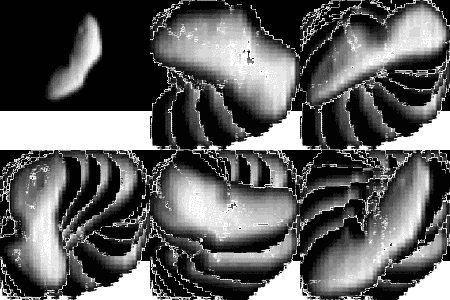 Eros Encounter Nears
10.02.2000
After an unanticipated extra trip around the Sun, the NEAR spacecraft is now politely approaching asteroid 433, Eros, at a respectful relative speed of about 20 miles per hour. Still nearly 2,000 miles distant, NEAR will close to within approximately 200 miles by February 14th - Valentine's Day.
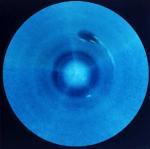 Southern Neptune
10.07.1999
Neptune, the Solar System's outermost gas giant planet, is 30 times farther from the Sun than Earth. Twelve years after a 1977 launch, Voyager 2 flew by Neptune and found surprising activity on a planet that receives only 3 percent as much sunlight as Jupiter.
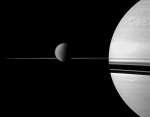 Titan, Rings, and Saturn from Cassini
8.03.2011
How thin are the rings of Saturn? Saturn's rings to be about one kilometer thick, making them many times thinner, in relative proportion, than a razor blade. This thinness sometimes appears in dramatic fashion during an image taken nearly along the ring plane.
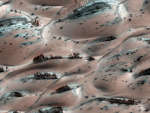 Dark Sand Cascades on Mars
25.11.2012
They might look like trees on Mars, but they're not. Groups of dark brown streaks have been photographed by the Mars Reconnaissance Orbiter on melting pinkish sand dunes covered with light frost. The above image was taken in 2008 April near the North Pole of Mars.
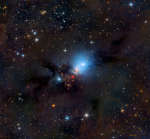 NGC 1333 Stardust
6.03.2014
NGC 1333 is seen in visible light as a reflection nebula, dominated by bluish hues characteristic of starlight reflected by dust. A mere 1,000 light-years distant toward the heroic constellation Perseus, it lies at the edge of a large, star-forming molecular cloud.
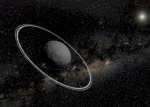 Two Rings for Asteroid Chariklo
9.04.2014
Asteroids can have rings. In a surprising discovery announced two weeks ago, the distant asteroid 10199 Chariklo was found to have at least two orbiting rings. Chariklo's diameter of about 250 kilometers makes it the largest of the measured centaur asteroids, but now the smallest known object to have rings.
|
January February |
|||||||||||||||||||||||||||||||||||||||||||||||||