
|
You entered: time
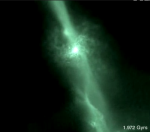 Simulation: A Disk Galaxy Forms
17.07.2012
How do galaxies like our Milky Way form? Since our universe moves too slowly to watch, faster-moving computer simulations are created to help find out. Green depicts (mostly) hydrogen gas in the above movie, while time is shown in billions of years since the Big Bang on the lower right.
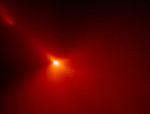 Near the Nucleus of Hyakutake
28.03.1996
NASA's Hubble Space Telescope captured this image of the near-nuclear region of Comet Hyakutake on March 25 as the comet approached within 9.3 million miles of the Earth. It covers a relatively "small" 2,000 mile wide area with the sunward direction toward the lower right (tailward is upper left).
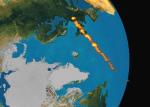 A Cosmic Snowball
30.05.1997
Like cosmic snowballs, fluffy comet-like objects the size of houses and composed mostly of water-ice, may be pummeling planet Earth 5 to 30 times a minute. This controversial theory was originally proposed in 1986 by Dr. Louis Frank (U. Iowa) based on data from NASA's Dynamics Explorer 1.
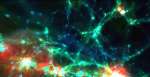 Illustris Simulation of the Universe
23.02.2020
How did we get here? Click play, sit back, and watch. A computer simulation of the evolution of the universe provides insight into how galaxies formed and perspectives into humanity's place in the universe.
 APOD: 2023 December 31 Б Illustris: A Simulation of the Universe
31.12.2023
How did we get here? Click play, sit back, and watch. A computer simulation of the evolution of the universe provides insight into how galaxies formed and perspectives into humanity's place in the universe.
 Neutrinos in the Sun
5.06.1998
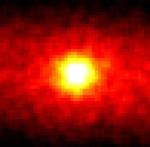
Neutrinos, along with things like electrons and quarks, are fundamental pieces of matter according to physicists' Standard Model. But neutrinos are hard to detect. Readily produced in nuclear reactions and particle collisions, they can easily pass completely through planet Earth without once interacting with any other particle.
 The Broad Tail of PanSTARRS
30.03.2013
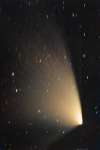
For northern hemisphere skygazers, fading Comet PanSTARRS (C/2011 L4) still hangs above the western horzion, after sunset but before moonrise in the coming days. Its perspective from planet Earth continues to reveal the comet's broad dust tail.
 M81 and Arp s Loop
9.12.2010
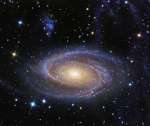
One of the brightest galaxies in planet Earth's sky and similar in size to the Milky Way, big, beautiful spiral M81 lies 11.8 million light-years away in the northern constellation Ursa Major. This...
 Illustris Simulation of the Universe
12.05.2014
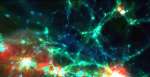
How did we get here? Click play, sit back, and watch. A new computer simulation of the evolution of the universe -- the largest and most sophisticated yet produced -- provides new insight into how galaxies formed and new perspectives into humanity's place in the universe.
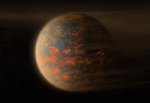 Cancri 55 e: Climate Patterns on a Lava World
5.04.2016
Why might you want to visit super-earth Cancri 55 e? Its extremely hot climate would be a deterrent, as mornings on this world might bring fresh lava flows. Discovered in 2004, the planet Cancri 55 e has twice the diameter of our Earth and about 10 times Earth's mass.
|
January February March April May June July August September |
|||||||||||||||||||||||||||||||||||||||||||||||||