
|
You entered: time
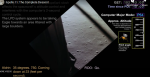 Apollo 11: Descent to the Moon
17.07.2019
It had never been done before. But with the words "You're Go for landing", 50 years ago this Saturday, Apollo 11 astronauts Aldrin and Armstrong were cleared to make the first try.
 APOD: 2025 January 5 Б Rocket Launch as Seen from the International Space Station
5.01.2025
Have you ever seen a rocket launch -- from space? A close inspection of the featured time-lapse video will reveal a rocket rising to Earth orbit as seen from the International Space Station (ISS).
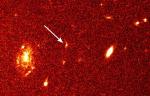 A Powerful Gamma Ray Burst
7.05.1998
Gamma-ray bursts are thought to be the most powerful explosions in the Universe, yet the cause of these high-energy flashes remains a mystery. Blindingly bright for space-based gamma-ray detectors the burst sources are so faint at visible wavelengths that large telescopes and sensitive cameras are required to search for them.
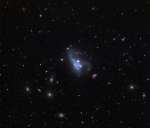 NGC 3239 and SN 2012A
27.01.2012
About 40,000 light-years across, pretty, irregular galaxy NGC 3239 lies near the center of this lovely field of galaxies in the galaxy rich constellation Leo. At a distance of only 25 million light-years...
 High Energy Stereoscopic System II
27.07.2012
The largest of its kind, the High Energy Stereoscopic System (H.E.S.S.) II telescope stands in the foreground of this photo. Tilted horizontally it reflects the inverted landscape of the Namibian desert in a segmented mirror 24 meters wide and 32 meters tall, equal in area to two tennis courts.
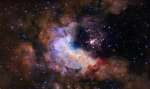 Celestial Fireworks: Into Star Cluster Westerlund 2
4.07.2017
What if you could go right into a cluster where stars are forming? A one-minute, time-lapse, video visualization of just this has been made with 3D computer modeling of the region surrounding the star cluster Westerlund 2, based on images from the Hubble Space Telescope in visible and infrared light.
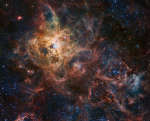 The Tarantula Zone
16.09.2022
The Tarantula Nebula, also known as 30 Doradus, is more than a thousand light-years in diameter, a giant star forming region within nearby satellite galaxy the Large Magellanic Cloud. About 180 thousand light-years away, it's the largest, most violent star forming region known in the whole Local Group of galaxies.
 Julius Caesar and Leap Days
29.02.2024
In 46 BC Julius Caesar reformed the calendar system. Based on advice by astronomer Sosigenes of Alexandria, the Julian calendar included one leap day every four years to account for the fact that an Earth year is slightly more than 365 days long.
 APOD: 2025 August 24 Б The Spinning Pulsar of the Crab Nebula
24.08.2025
At the core of the Crab Nebula lies a city-sized, magnetized neutron star spinning 30 times a second. Known as the Crab Pulsar, it is the bright spot in the center of the gaseous swirl at the nebula's core.
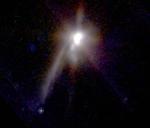 An Extrasolar Planet?
29.05.1998
This infrared Hubble Space Telescope view may contain the first ever direct image of a planet outside our own solar system. The picture shows a very young double star located about 450 light-years away toward the constellation of Taurus.
|
January February March April May June July August September |
|||||||||||||||||||||||||||||||||||||||||||||||||