
|
You entered: dust
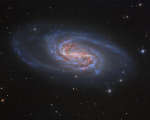 NGC 2903: A Missing Jewel in Leo
10.04.2015
Barred spiral galaxy NGC 2903 is only some 20 million light-years distant. Popular among amateur astronomers, it shines in the northern spring constellation Leo, near the top of the lion's head. That part of the constellation is sometimes seen as a reversed question mark or sickle.
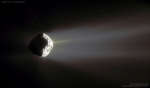 Comet Churyumov Gerasimenko in Crescent
29.04.2015
What's happening to Comet 67P/ChuryumovGerasimenko? As the 3-km wide comet moves closer to the Sun, heat causes the nucleus to expel gas and dust. The Rosetta spacecraft arrived at the comet's craggily double nucleus last July and now is co-orbiting the Sun with the giant dark iceberg.
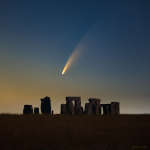 Comet NEOWISE over Stonehenge
14.07.2020
Have you ever seen a comet? Tonight -- and likely the next few nights -- should be a good chance. Go outside just at sunset and look to your northwest. The lower your horizon, the better. Binoculars may help, but if your sky is cloudless and dark, all you should need is your unaided eyes and patience.
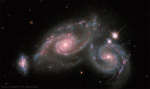 APOD: 2023 January 23 Б The Colliding Spiral Galaxies of Arp 274
23.01.2023
Two galaxies are squaring off in Virgo and here are the latest pictures. When two galaxies collide, the stars that compose them usually do not. This is because galaxies are mostly empty space and, however bright, stars only take up only a small fraction of that space.
 Phantoms in Cassiopeia
26.10.2024
These brightly outlined flowing shapes look ghostly on a cosmic scale. A telescopic view toward the constellation Cassiopeia, the colorful skyscape features the swept-back, comet-shaped clouds IC 59 (left) and IC 63. About 600 light-years distant, the clouds aren't actually ghosts.
 APOD: 2025 August 31 Б NGC 7027: The Pillow Planetary Nebula
31.08.2025
What created this unusual planetary nebula? Dubbed the Pillow Nebula and the Flying Carpet Nebula, NGC 7027 is one of the smallest, brightest, and most unusually shaped planetary nebulas known. Given its expansion rate, NGC 7027 first started expanding, as visible from Earth, about 600 years ago.
 APOD: 2026 January 18 Б Jupiter from the Webb Space Telescope
18.01.2026
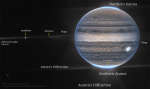
This infrared view of Jupiter by Webb is illuminating. High-resolution infrared images of Jupiter from the James Webb Space Telescope (Webb) reveal, for example, differences between high-floating bright clouds -- including the Great Red Spot -- and low-lying dark clouds.
 LDN 1622: Dark Nebula in Orion
22.01.2026
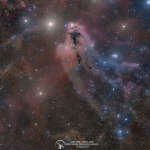
The silhouette of an intriguing dark nebula inhabits this cosmic scene. Lynds' Dark Nebula (LDN) 1622 appears against a faint background of glowing hydrogen gas only visible in long telescopic exposures of the region. In contrast, a brighter reflection nebula, vdB 62, is more easily seen just above the dusty dark nebula.
 APOD: 2026 August 4 Б Curious Cometary Knots in the Helix Nebula
4.08.2026
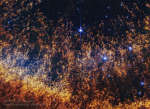
What causes unusual knots of gas and dust in planetary nebulas? Seen also in the Ring Nebula, the Dumbbell Nebula and NGC 2392, the knots' existence was not initially predicted, and their origins are still not well understood.
 An Orion Deep Field
15.01.2004
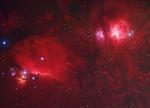
Adrift 1,500 light-years away in one of the night sky's most recognizable constellations, the glowing Orion Nebula and the dark Horsehead Nebula are contrasting cosmic vistas. They both appear in this stunning composite digital image assembled from over 20 hours of data that includes exposures filtered to record emission from hydrogen atoms.
|
January February March April May June July August September |
|||||||||||||||||||||||||||||||||||||||||||||||||