
|
You entered: dust
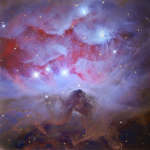 Reflections on the 1970s
13.01.2016
The 1970s are sometimes ignored by astronomers, like this beautiful grouping of reflection nebulae in Orion - NGC 1977, NGC 1975, and NGC 1973 - usually overlooked in favor of the substantial glow from the nearby stellar nursery better known as the Orion Nebula.
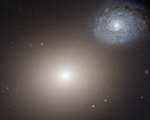 Elliptical M60, Spiral NGC 4647
28.01.2016
Giant elliptical galaxy M60 and spiral galaxy NGC 4647 do look like an odd couple in this sharp cosmic portrait from the Hubble Space Telescope. But they are found in a region of space where galaxies tend to gather, on the eastern side of the nearby Virgo Galaxy Cluster.
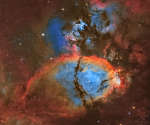 IC 1795: The Fishhead Nebula
31.07.2019
To some, this nebula looks like the head of a fish. However, this colorful cosmic portrait really features glowing gas and obscuring dust clouds in IC 1795, a star forming region in the northern constellation Cassiopeia.
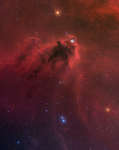 LDN 1622: Dark Nebula in Orion
21.02.2020
The silhouette of an intriguing dark nebula inhabits this cosmic scene. Lynds' Dark Nebula (LDN) 1622 appears against a faint background of glowing hydrogen gas only visible in long telescopic exposures of the region. In contrast, the brighter reflection nebula vdB 62 is more easily seen, just above and right of center.
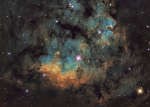 NGC 7822 in Cepheus
20.01.2022
Hot, young stars and cosmic pillars of gas and dust seem to crowd into NGC 7822. At the edge of a giant molecular cloud toward the northern constellation Cepheus, the glowing star forming region lies about 3,000 light-years away. Within the nebula, bright edges and dark shapes stand out in this colorful telescopic skyscape.
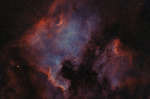 North America and the Pelican
8.09.2022
Fans of our fair planet might recognize the outlines of these cosmic clouds. On the left, bright emission outlined by dark, obscuring dust lanes seems to trace a continental shape, lending the popular name North America Nebula to the emission region cataloged as NGC 7000.
 Milky Way Rising
1.12.2023
The core of the Milky Way is rising beyond the Chilean mountain-top La Silla Observatory in this deep night skyscape. Seen toward the constellation Sagittarius, our home galaxy's center is flanked...
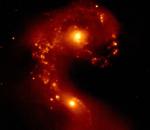 Antennae Galaxies in Near Infrared
11.04.2002
What happens when galaxies collide? One of the best studied examples of the jumble of star clusters, gas, and dust clouds produced by such a cosmic train wreck is the interacting galaxy pair NGC 4038 / NGC 4039, the Antennae Galaxies, only sixty million light-years away.
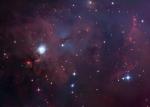 NGC 1999: South of Orion
30.01.2006
South of the large star-forming region known as the Orion Nebula, lies bright blue reflection nebula NGC 1999. The nebula is marked with a dark inverted T-shape at the lower left in a broad cosmic vista that spans over 10 light-years.
 Sandy Gas Jets Hypothesized on Mars
23.08.2006
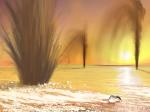
What's causing seasonal dark spots on Mars? Every spring, strange dark spots appear near the Martian poles, and then vanish a few months later. These spots typically span 50 meters across and appear fan shaped. Recent observations made with THEMIS instrument onboard NASA's Mars Odyssey, currently orbiting Marscarbon dioxide (CO2) ice beneath them.
|
January February March April May June July August September |
|||||||||||||||||||||||||||||||||||||||||||||||||