
|
You entered: star system
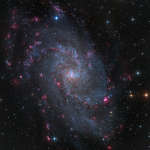 M33: The Triangulum Galaxy
12.11.2021
The small, northern constellation Triangulum harbors this magnificent face-on spiral galaxy, M33. Its popular names include the Pinwheel Galaxy or just the Triangulum Galaxy. M33 is over 50,000 light-years in diameter, third largest in the Local Group of galaxies after the Andromeda Galaxy (M31), and our own Milky Way.
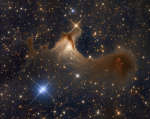 Ghost of the Cepheus Flare
30.10.2010
Spooky shapes seem to haunt this starry expanse, drifting through the night in the royal constellation Cepheus. Of course, the shapes are cosmic dust clouds faintly visible in dimly reflected starlight. Far from your...
 Rigil Kentaurus and Sandqvist 169
13.04.2019
Rigil Kentaurus is the bright star near the top of this broad southern skyscape. Of course it's probably better known as Alpha Centauri, nearest star system to the Sun. Below it sprawls a dark nebula complex.
 Globular Star Cluster 47 Tuc
16.01.2011
Globular star cluster 47 Tucanae is a jewel of the southern sky. Also known as NGC 104, it roams the halo of our Milky Way Galaxy along with some 200 other globular star clusters.
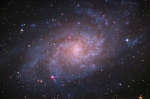 M33: Triangulum Galaxy
27.09.2018
The small, northern constellation Triangulum harbors this magnificent face-on spiral galaxy, M33. Its popular names include the Pinwheel Galaxy or just the Triangulum Galaxy. M33 is over 50,000 light-years in diameter, third largest in the Local Group of galaxies after the Andromeda Galaxy (M31), and our own Milky Way.
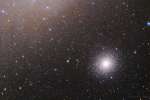 47 Tuc Near the Small Magellanic Cloud
6.12.2012
Globular star cluster 47 Tucanae is a jewel of the southern sky. Also known as NGC 104, it roams the halo of our Milky Way Galaxy along with around 200 other globular star clusters.
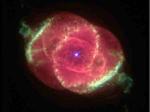 The Cats Eye Nebula
24.03.2002
Three thousand light-years away, a dying star throws off shells of glowing gas. This image from the Hubble Space Telescope reveals the Cat's Eye Nebula to be one of the most complex planetary nebulae known.
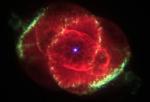 The Cat's Eye Nebula
2.08.1997
Three thousand light years away, a dying star throws off shells of glowing gas. This image from the Hubble Space Telescope reveals "The Cat's Eye Nebula" to be one of the most complex planetary nebulae known.
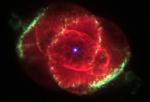 The Cat's Eye Nebula
1.11.1998
Three thousand light years away, a dying star throws off shells of glowing gas. This image from the Hubble Space Telescope reveals The Cat's Eye Nebula to be one of the most complex planetary nebulae known.
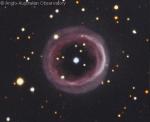 Shapley 1: An Annular Planetary Nebula
25.06.2000
What happens when a star runs out of nuclear fuel? The center condenses into a white dwarf while the outer atmospheric layers are expelled into space and appear as a planetary nebula. This particular planetary nebula, designated Shapley 1 after the famous astronomer Harlow Shapley, has a very apparent annular ring like structure.
|
January February March April May June July August September |
|||||||||||||||||||||||||||||||||||||||||||||||||