
|
You entered: remnants
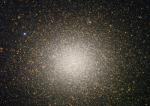 NGC 5139: Omega Centauri
19.04.2007
Centaurus is one of the most striking constellations in the southern sky. The Milky Way flows through this celestial expanse whose wonders also include the closest star system to the Sun, Alpha Centauri, and the largest globular star cluster in our galaxy, Omega Centauri (aka NGC 5139).
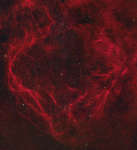 RCW 114: A Dragon s Heart in Ara
10.01.2018
Large and dramatically shaped, this cosmic cloud spans nearly 7 degrees or 14 full moons across planet Earth's sky toward the southern constellation Ara. Difficult to image, the filamentary apparition is cataloged as RCW 114 and traced in this telescopic mosaic by the telltale reddish emission of ionized hydrogen atoms.
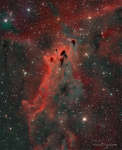 APOD: 2026 April 28 Б CG 30: Cometary Globules
27.04.2026
They're like mountain peaks, but they are forming stars. Bright-rimmed, flowing shapes gather near the center of this rich starfield toward the borders of the nautical southern constellations Puppis and Vela. Composed of interstellar gas and dust, the grouping of light-year sized cometary globules is about 1300 light-years distant.
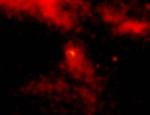 Pulsar Wind in the Vela Nebula
19.07.2001
The Vela pulsar was born 10,000 years ago at the center of a supernova -- an exploding star. In this Chandra Observatory x-ray image, the pulsar still produces a glowing nebula at the heart of the expanding cloud of stellar debris.
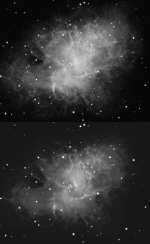 The Incredible Expanding Crab
26.12.2001
The Crab Nebula is cataloged as M1, the first on Charles Messier's famous list of things which are not comets. In fact, the Crab is now known to be a supernova remnant, an expanding cloud of debris from the explosion of a massive star.
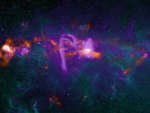 Our Galaxy s Central Molecular Zone
9.11.2008
The central region of our Milky Way Galaxy is a mysterious and complex place. Pictured here in radio and infrared light, the galaxy's central square degree is highlighted in fine detail. The region is known as the Central Molecular Zone.
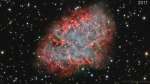 M1: The Incredible Expanding Crab
3.01.2018
The Crab Nebula is cataloged as M1, the first on Charles Messier's famous list of things which are not comets. In fact, the Crab is now known to be a supernova remnant, an expanding cloud of debris from the explosion of a massive star.
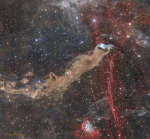 Wolfs Cave Nebula
14.11.2022
The mysterious blue reflection nebula found in catalogs as VdB 152 or Ced 201 really is very faint. It lies at the tip of the long dark nebula Barnard 175 in a dusty complex that has also been called Wolf's Cave.
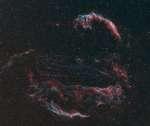 The Veil Nebula
16.09.2010
Delicate in appearance, these filaments of shocked, glowing gas, draped in planet Earth's sky toward the constellation of Cygnus, make up the Veil Nebula. The nebula is a large supernova remnant, an expanding cloud born of the death explosion of a massive star.
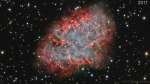 APOD: 2023 March 20 Б M1: The Expanding Crab Nebula
19.03.2023
Are your eyes good enough to see the Crab Nebula expand? The Crab Nebula is cataloged as M1, the first on Charles Messier's famous list of things which are not comets. In fact...
|
January February March April May June July August September October |
|||||||||||||||||||||||||||||||||||||||||||||||||