
|
You entered: remnants
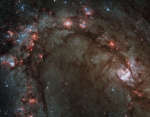 M83s Center from Refurbished Hubble
15.11.2009
What's happening at the center of spiral galaxy M83? Just about everything, from the looks of it. M83 is one of the closest spiral galaxies to our own Milky Way Galaxy and from a distance of 15 million light-years, appears to be relatively normal.
 The Tarantula Zone
26.04.2008
The Tarantula Nebula is more than 1,000 light-years in diameter -- a giant star forming region within our neighboring galaxy the Large Magellanic Cloud (LMC). That cosmic arachnid lies at the upper left of this expansive mosiac covering a part of the LMC over 6,000 light-years across.
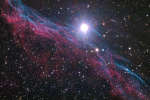 NGC 6960: The Witch s Broom Nebula
19.08.2008
Ten thousand years ago, before the dawn of recorded human history, a new light must suddenly have appeared in the night sky and faded after a few weeks. Today we know this light was an exploding star and record the colorful expanding cloud as the Veil Nebula.
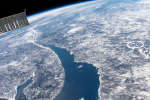 Manicouagan Impact Crater from Space
1.05.2019
Orbiting 400 kilometers above Quebec, Canada, planet Earth, the International Space Station Expedition 59 crew captured this snapshot of the broad St. Lawrence River and curiously circular Lake Manicouagan on April 11. Right of center, the ring-shaped lake is a modern reservoir within the eroded remnant of an ancient 100 kilometer diameter impact crater.
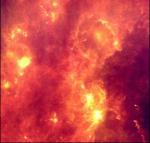 IRAS Orion
31.07.1998
Do you recognize the constellation Orion? This striking but unfamiliar looking picture of the familiar Orion region of the sky was produced using survey data from the InfraRed Astronomical Satellite (IRAS). It combines information...
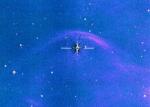 Runaway Star
26.11.1999
Runaway stars are massive stars traveling rapidly through interstellar space. Like a ship plowing through the interstellar medium, runaway star HD 77581 has produced this graceful arcing bow wave or "bow shock" - compressing the gaseous material in its path.
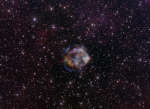 Cas A: Optical and X ray
17.01.2013
The aftermath of a cosmic cataclysm, supernova remnant Cassiopeia A (Cas A) is a comfortable 11,000 light-years away. Light from the Cas A supernova, the death explosion of a massive star, first reached Earth just 330 years ago.
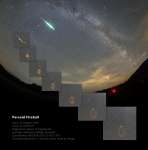 Perseid Fireball and Persistent Train
16.08.2018
Before local midnight on August 12, this brilliant Perseid meteor flashed above the Poloniny Dark Sky Park, Slovakia, planet Earth. Streaking beside the summer Milky Way, its initial color is likely due to the shower meteor's characteristically high speed.
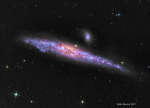 NGC 4631: The Whale Galaxy
5.10.2022
NGC 4631 is a big beautiful spiral galaxy. Seen edge-on, it lies only 25 million light-years away in the well-trained northern constellation Canes Venatici. The galaxy's slightly distorted wedge shape suggests to some a cosmic herring and to others its popular moniker, The Whale Galaxy.
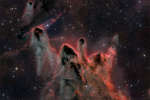 APOD: 2024 July 16 Б Cometary Globules
15.07.2024
What are these unusual interstellar structures? Bright-rimmed, flowing shapes gather near the center of this rich starfield toward the borders of the nautical southern constellations Pupis and Vela. Composed of interstellar gas and dust, the grouping of light-year sized cometary globules is about 1300 light-years distant.
|
January February March April May June July August September October |
|||||||||||||||||||||||||||||||||||||||||||||||||