
|
You entered: impact
 APOD: 2023 August 23 Б The Meteor and the Galaxy
23.08.2023
It came from outer space. It -- in this case a sand-sized bit of a comet nucleus -- was likely ejected many years ago from Sun-orbiting Comet Swift-Tuttle, but then continued to orbit the Sun alone.
 Northern Lights, West Virginia
12.10.2024
A gravel country lane gently winds through this colorful rural night skyscape. Captured from Monroe County in southern West Virginia on the evening of October 10, the starry sky above is a familiar sight. Shimmering curtains of aurora borealis or northern lights definitely do not make regular appearances here, though.
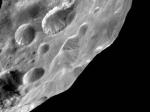 Unusual Layers on Saturns Moon Phoebe
14.06.2004
What caused the unusual light and dark layers on Saturn's moon Phoebe? The layers were discovered just Friday during the Cassini spacecraft flyby of the small moon. Such layering is particularly evident on the crater just above the image center, where alternating light and dark material makes this crater appear particularly structured.
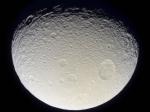 Saturns Moon Tethys from Cassini
29.11.2004
Tethys is one of the larger and closer moons of Saturn. The Cassini spacecraft now orbiting Saturn passed near the frozen moon at the end of October, capturing the most detailed images since the Voyager spacecrafts in the early 1980s.
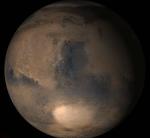 Northern Spring on Mars
25.03.2006
Astronomical spring came to planet Earth's northern hemisphere this week (and autumn to the south) with the equinox on March 20th. But on Mars, northern spring began on January 22nd. Still in northern...
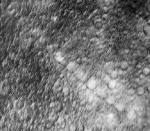 The Crater Chain
15.07.1995
NASA's robot spaceprobe Voyager 1, took this closeup image of the surface of Jupiter's crater scarred moon Callisto in 1979. A mysterious chain of craters is seen to extend diagonally across the image (upper left to lower right). What could cause the craters to line up in such a regular fashion?
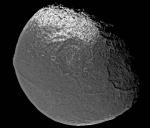 Saturns Iapetus: Moon with a Strange Surface
1.02.2005
What has happened to Saturn's moon Iapetus? A strange ridge crosses the moon near the equator, visible near the bottom of the above image, making Iapetus appear similar to the pit of a peach. Half of Iapetus is so dark that it can nearly disappear when viewed from Earth.
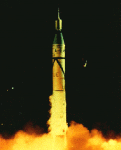 The First Explorer
6.02.1999
The first US spacecraft was Explorer 1. The cylindrical 30 pound satellite was launched (above) as the fourth stage of a Jupiter-C rocket (a modified US Army Redstone ballistic missile) and achieved orbit on January 31, 1958.
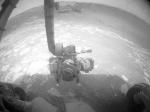 Inside Victoria Crater on Mars
17.09.2007
NASA's Opportunity rover is now inside Victoria Crater on Mars. Last week the robot rolled about 20 meters into the largest crater any Martian rover has yet encountered, the crater next to which Opportunity has been perched for months.
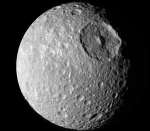 Mimas: Small Moon with a Big Crater
17.05.2009
Whatever hit Mimas nearly destroyed it. What remains is one of the largest impact craters on one of Saturn's smallest moons. The crater, named Herschel after the 1789 discoverer of Mimas, Sir William Herschel, spans about 130 kilometers and is pictured above.
|
January February |
|||||||||||||||||||||||||||||||||||||||||||||||||