
|
You entered: impact
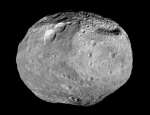 Leaving Vesta
19.09.2012
Next stop: Ceres. Last week the robotic Dawn spacecraft ended its year-long mission to asteroid Vesta, becoming the first spacecraft ever to visit this far off world located between Mars and Jupiter, in the Solar System's main asteroid belt.
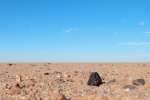 Almahata Sitta 15
28.03.2009
Small asteroid 2008 TC3 fell to Earth at dawn on October 7, 2008, tracking through the skies over the Nubian Desert in northern Sudan. That event was remarkable because it was the first time an asteroid was detected in space before crashing into planet Earth's atmosphere.
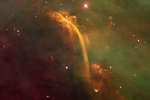 HH 222: The Waterfall Nebula
24.10.2011
What created the Waterfall Nebula? No one knows. The structure seen in the region of NGC 1999 in the Great Orion Molecular Cloud complex is one of the more mysterious structures yet found on the sky. Designated HH-222, the elongated gaseous stream stretches about ten light years and emits an unusual array of colors.
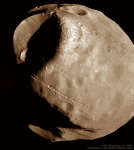 Phobos: Doomed Moon of Mars
25.11.2018
This moon is doomed. Mars, the red planet named for the Roman god of war, has two tiny moons, Phobos and Deimos, whose names are derived from the Greek for Fear and Panic. The origin of the Martian moons is unknown, though, with a leading hypothesis holding that they are captured asteroids.
 Tagging Bennu: The Movie
3.11.2020
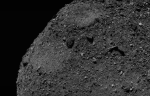
This is what it looks like to punch an asteroid. Last month, NASA's robotic spacecraft OSIRIS-REx descended toward, thumped into, and then quickly moved away from the small near-Earth asteroid 101955 Bennu. The featured video depicts the Touch-And-Go (TAG) sampling event over a three-hour period.
 Marius Hills: Holes in the Moon
25.10.2017
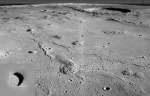
Could humans live beneath the surface of the Moon? This intriguing possibility was bolstered in 2009 when Japan's Moon-orbiting SELENE spacecraft imaged a curious hole beneath the Marius Hills region on the Moon, possibly a skylight to an underground lava tube.
 Saturns Iapetus: Painted Moon
9.08.2009
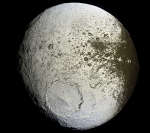
What has happened to Saturn's moon Iapetus? Vast sections of this strange world are dark as coal, while others are as bright as ice. The composition of the dark material is unknown, but infrared spectra indicate that it possibly contains some dark form of carbon.
 Saturns Iapetus: Painted Moon
13.01.2012
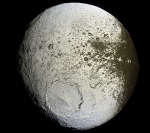
What has happened to Saturn's moon Iapetus? Vast sections of this strange world are dark as coal, while others are as bright as ice. The composition of the dark material is unknown, but infrared spectra indicate that it possibly contains some dark form of carbon.
 A Cosmic Snowball
30.05.1997
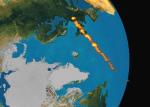
Like cosmic snowballs, fluffy comet-like objects the size of houses and composed mostly of water-ice, may be pummeling planet Earth 5 to 30 times a minute. This controversial theory was originally proposed in 1986 by Dr. Louis Frank (U. Iowa) based on data from NASA's Dynamics Explorer 1.
 Gravel Ejected from Asteroid Bennu
16.09.2020
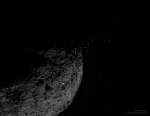
Why does asteroid Bennu eject gravel into space? No one is sure. The discovery, occurring during several episodes by NASA's visiting ORISIS-REx spacecraft, was unexpected. Leading ejection hypotheses include impacts by Sun-orbiting meteoroids, sudden thermal fractures of internal structures, and the sudden release of a water vapor jet.
|
January February March April May June July August |
||||||||||||||||||||||||||||||||||||||||||||||||||||||||