
|
You entered: stars
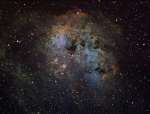 IC 410 and NGC 1893
16.01.2009
Dusty emission nebula IC 410 lies about 12,000 light-years away in the northern constellation Auriga. The cloud of glowing gas is over 100 light-years across, sculpted by stellar winds and radiation from embedded open star cluster NGC 1893.
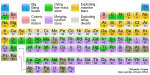 Where Your Elements Came From
23.10.2017
The hydrogen in your body, present in every molecule of water, came from the Big Bang. There are no other appreciable sources of hydrogen in the universe. The carbon in your body was made by nuclear fusion in the interior of stars, as was the oxygen.
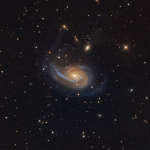 Arp 78: Peculiar Galaxy in Aries
17.09.2020
(xxxedit and linkxxx) Peculiar spiral galaxy Arp 78 is found within the boundaries of the head strong constellation Aries, some 100 million light-years beyond the stars and nebulae of our Milky Way galaxy. Also...
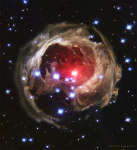 Light Echoes from V838 Mon
25.06.2022
What caused this outburst of V838 Mon? For reasons unknown, star V838 Mon's outer surface suddenly greatly expanded with the result that it became one of the brighter stars in the Milky Way Galaxy in early 2002. Then, just as suddenly, it shrunk and faded.
 APOD: 2025 May 13 Б Gaia Reconstructs a Top View of our Galaxy
12.05.2025
What does our Milky Way Galaxy look like from the top? Because we are on the inside, humanity canБt get an actual picture. Recently, however, just such a map has been made using location data for over a billion stars from ESAБs Gaia mission.
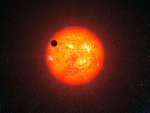 Extrasolar Super Earth Gliese 1214b Might Hold Water
10.09.2013
Might this distant planet hold water? Actually, given how close Gliese 1214b is to its parent star, any water, if it exists, would surely be in the form of steam. In the above artist...
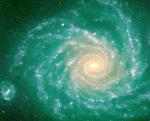 Spiral Galaxy NGC 1232
22.05.2001
Galaxies are fascinating not only for what is visible, but for what is invisible. Grand spiral galaxy NGC 1232, captured in detail by one of the new Very Large Telescopes, is a good example.
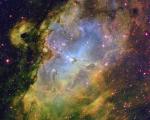 Inside the Eagle Nebula
11.06.2002
From afar, the whole thing looks like an Eagle. A closer look of the Eagle Nebula, however, shows the bright region is actually a window into the center of a larger dark shell of dust. Through this window, a brightly-lit workshop appears where a whole open cluster of stars is being formed.
 The Tarantula Nebula
5.01.2006
First cataloged as a star, 30 Doradus is actually an immense star forming region in nearby galaxy The Large Magellanic Cloud. The region's spidery appearance is responsible for its popular name, the Tarantula Nebula, except that this tarantula is about 1,000 light-years across, and 180,000 light-years away in the southern constellation Dorado.
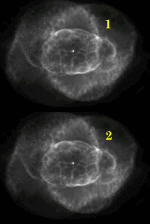 The Incredible Expanding Cats Eye
16.09.1999
Watch closely. As this animation blinks between two Hubble Space Telescope images of NGC 6543 - the first from 1994 and the second from 1997 - the intricate filaments of this nebula are seen to shift. The shift is due to the actual expansion of this gaseous shroud shed by a dying star!
|
January February March April May June July August September |
|||||||||||||||||||||||||||||||||||||||||||||||||