
|
You entered: stars
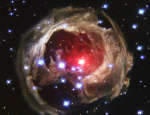 Light Echoes from V838 Mon
17.03.2013
What caused this outburst of V838 Mon? For reasons unknown, star V838 Mon's outer surface suddenly greatly expanded with the result that it became the brightest star in the entire Milky Way Galaxy in January 2002. Then, just as suddenly, it faded.
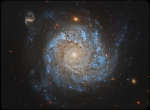 NGC 1309: Spiral Galaxy and Friends
14.07.2016
A gorgeous spiral galaxy some 100 million light-years distant, NGC 1309 lies on the banks of the constellation of the River (Eridanus). NGC 1309 spans about 30,000 light-years, making it about one third the size of our larger Milky Way galaxy.
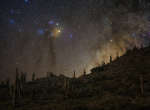 Deepscape at Yacoraite
8.05.2021
In this evocative night scene a dusty central Milky Way rises over the ancient Andean archaeological site of Yacoraite in northwestern Argentina. The denizens of planet Earth reaching skyward are the large Argentine saguaro cactus currently native to the arid region.
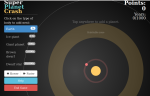 Game: Super Planet Crash
19.06.2022
Can you create a planetary system that lasts for 1000 years? Super Planet Crash, the featured game, allows you to try. To create up to ten planets, just click anywhere near the central star.
 Curly Spiral Galaxy M63
19.05.2023
A bright spiral galaxy of the northern sky, Messier 63 is nearby, about 30 million light-years distant toward the loyal constellation Canes Venatici. Also cataloged as NGC 5055, the majestic island universe is nearly 100,000 light-years across, about the size of our own Milky Way.
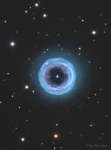 APOD: 2026 March 4 Б Shapley 1: An Annular Planetary Nebula
4.03.2026
WhatБs looking back at you isnБt a cosmic eye, but Shapley 1, a beautifully symmetric planetary nebula. Shapley 1, also known as the Fine Ring Nebula or PLN 329+2.1, bejewels the southern sky constellation of the Carpenter's Square (Norma).
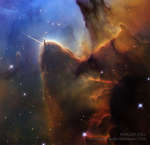 APOD: 2026 May 3 Б Trifid Pillars and Jets
3.05.2026
Dust pillars are like interstellar mountains. They survive because they are more dense than their surroundings, but they are slowly being eroded away by a hostile environment. Visible in the featured picture...
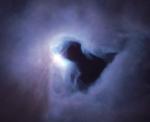 NGC 1999: Reflection Nebula In Orion
2.03.2000
A dusty bright nebula contrasts dramatically with a dusty dark nebula in this Hubble Space Telescope image recorded shortly after December's orbital servicing mission. The nebula, cataloged as NGC 1999, is a reflection nebula, which shines by reflecting light from a nearby star.
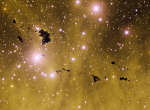 Thackerays Globules
12.06.2012
These are larger dust bunnies than you will find under your bed. Situated in rich star fields and glowing hydrogen gas, these opaque clouds of interstellar dust and gas are so large they might be able to form stars.
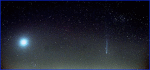 Comet Hyakutake on a Starry Night
23.04.1996
It was a starry night in April (April 9th, 1996, 9:32 pm CDT to be exact) near Lone Jack, Missouri when Comet Hyakutake graced this astronomically rich field. Making an appearance as the brilliant evening star, Venus is overexposed at the far left.
|
January February March April May June July August September |
|||||||||||||||||||||||||||||||||||||||||||||||||