
|
You entered: orbit
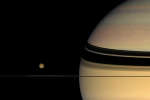 Moons, Rings, and Unexpected Colors on Saturn
20.10.2008
Why would Saturn show such strange colors? The robotic Cassini spacecraft currently orbiting Saturn has beamed back images showing that the northern hemisphere our Solar System's most spectacularly ringed planet has changed noticeably since Cassini arrived in 2004, now sporting unusual and unexpected colors. No one is sure why.
 Earth at Night
7.12.2012
This remarkably complete view of Earth at night is a composite of cloud-free, nighttime images. The images were collected during April and October 2012 by the Suomi-NPP satellite from polar orbit about 824 kilometers (512 miles) above the surface using its Visible Infrared Imaging Radiometer Suite (VIIRS).
 Planet Earth from Orion
17.11.2022
A Space Launch System rocket left planet Earth on Wednesday, November 16 at 1:47am EST carrying the Orion spacecraft on the Artemis 1 mission, the first integrated test of NASAБs deep space exploration systems.
 APOD: 2024 September 25 Б Comet A3 Through an Australian Sunrise
25.09.2024
Comet Tsuchinshan-ATLAS is now visible in the early morning sky. Diving into the inner Solar System at an odd angle, this large dirty iceberg will pass its closest to the Sun -- between the orbits of Mercury and Venus -- in just two days.
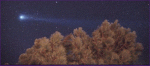 Comet Hyakutake and a Tree
10.04.1996
Comet Hyakutake is still visible as it continues its orbit around the Sun. The comet will brighten again in late April and early May. The above fascinating picture was taken with a three minute exposure. In the middle of the exposure, the photographer cleverly set off a flash, momentarily illuminating the foreground tree.
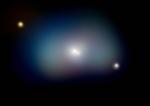 NGC 1700: Elliptical Galaxy and Rotating Disk
16.01.2003
In spiral galaxies, majestic winding arms of young stars and interstellar gas and dust rotate in a disk around a bulging galactic nucleus. Elliptical galaxies seem to be simpler, randomly swarming with old stars and lacking gas and dust.
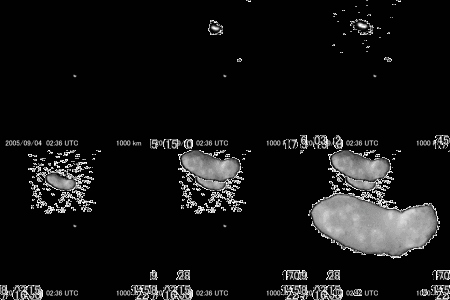 Approaching Asteroid Itokawa
19.09.2005
What are asteroids made of? To help find out, Japan's JAXA space agency launched the Hayabusa mission to rendezvous with asteroid Itokawa. Last week, the small robotic Hayabusa spacecraft arrived at asteroid Itokawa and stationed itself only 20 kilometers away.
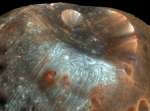 Stickney Crater
10.04.2008
Stickney Crater, the largest crater on the martian moon Phobos, is named for Chloe Angeline Stickney Hall, mathematician and wife of astronomer Asaph Hall. Asaph Hall discovered both the Red Planet's moons in 1877.
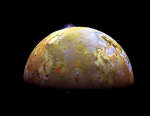 Io: The Prometheus Plume
22.05.2011
What's happening on Jupiter's moon Io? Two sulfurous eruptions are visible on Jupiter's volcanic moon Io in this color composite image from the robotic Galileo spacecraft that orbited Jupiter from 1995 to 2003.
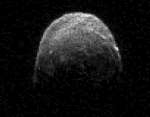 Asteroid 2005 YU55 Passes the Earth
9.11.2011
Asteroid 2005 YU55 passed by the Earth yesterday, posing no danger. The space rock, estimated to be about 400 meters across, coasted by just inside the orbit of Earth's Moon. Although the passing...
|
January February March April May June July August September |
|||||||||||||||||||||||||||||||||||||||||||||||||