
|
You entered: orbit
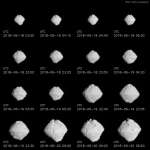 Hayabusa2 Approaches Asteroid Ryugu
25.06.2018
It looks like a big space diamond -- but with craters. It's 162173 Ryugu (Dragon's Castle), and Japan's robotic Hayabusa2 mission is now arriving at this near-Earth asteroid. Ambitious Hayabusa2 is carrying...
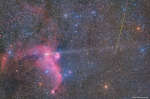 Meteor, Comet, and Seagull (Nebula)
21.10.2018
A meteor, a comet, and a photogenic nebula have all been captured in this single image. The closest and most fleeting is the streaking meteor on the upper right -- it was visible for less than a second.
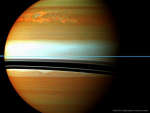 A Long Storm System on Saturn
15.09.2019
It was one of the largest and longest lived storms ever recorded in our Solar System. First seen in late 2010, the above cloud formation in the northern hemisphere of Saturn started larger than the Earth and soon spread completely around the planet.
 APOD: 2023 September 13 Б NGC 4632: Galaxy with a Hidden Polar Ring
13.09.2023
Galaxy NGC 4632 hides a secret from optical telescopes. It is surrounded by a ring of cool hydrogen gas orbiting at 90 degrees to its spiral disk. Such polar ring galaxies have previously been discovered using starlight. However, NGC 4632 is among the first in which a radio telescope survey revealed a polar ring.
 A Perseid Below
9.08.2024
Denizens of planet Earth typically watch meteor showers by looking up. But this remarkable view, captured on August 13, 2011 by astronaut Ron Garan, caught a Perseid meteor by looking down. From Garan...
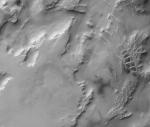 Rectangular Ridges on Mars
1.10.2002
What could cause rectangular ridges on Mars? As data flows in from the two spacecraft currently orbiting Mars, surface structures are seen that are not immediately understood. These structures pose puzzles that planetary geologists are eager to solve, as they might provide clues to past processes that have shaped Mars over billions of years.
 A High Energy Fleet
25.05.1997
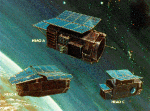
Looking like a fleet of futuristic starcruisers, NASA's highly successful series of High Energy Astrophysical Observatory (HEAO) spacecraft appear poised over planet Earth. Labeled A, B, and C in this vintage illustration, the spacebased telescopes were known as HEAO-1, HEAO-2, and HEAO-3 respectively.
 An Aurora Before the Storm
19.05.2000
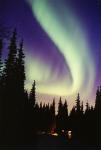
Early April brought some of the most intense auroral storms this decade. An aurora on April 6 was reported to be the largest visible on Earth since 1989, and was seen throughout Europe and much of northern North America.
 The Gegenschein Over Chile
7.05.2008
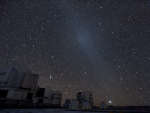
Is the night sky darkest in the direction opposite the Sun? No. In fact, a rarely discernable faint glow known as the gegenschein (German for "counter glow") can be seen 180 degrees around from the Sun in an extremely dark sky. The gegenschein is sunlight back-scattered off small interplanetary dust particles.
 Meteors Over Quebec
16.08.2010
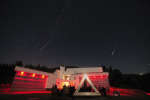
Meteors streaked through the sky above many of Earth's cities last week, but nobody was hurt, and no damage has been reported. The assault from space appeared to originate from someplace in the constellation of Perseus, and included millions of small projectiles hurtling toward Earth at over 200,000 kilometers per hour.
|
January February March April May June July August September |
|||||||||||||||||||||||||||||||||||||||||||||||||