
|
You entered: NASA
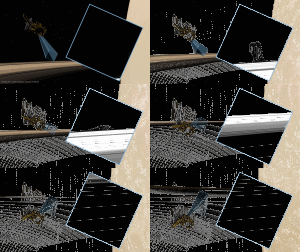 Saturns Rings from the Inside Out
4.09.2017
What do Saturn's rings look like from Saturn? Images from the robotic spacecraft Cassini are providing humanity with this unprecedented vantage point as it nears the completion of its mission. Previous to Cassini's Grand Finale orbits, all images of Saturn's majestic ring system were taken from outside of the rings looking in.
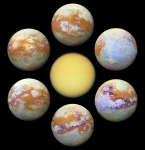 Seeing Titan
18.08.2018
Shrouded in a thick atmosphere, Saturn's largest moon Titan really is hard to see. Small particles suspended in the upper atmosphere cause an almost impenetrable haze, strongly scattering light at visible wavelengths and hiding Titan's surface features from prying eyes.
 The Mountains of NGC 2174
16.01.2021
This fantastic skyscape lies near the edge of NGC 2174 a star forming region about 6,400 light-years away in the nebula-rich constellation of Orion. It follows mountainous clouds of gas and dust carved...
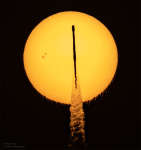 Rocket Transits Rippling Sun
31.05.2022
The launch of a rocket at sunrise can result in unusual but intriguing images that feature both the rocket and the Sun. Such was the case last month when a SpaceX Falcon 9 rocket blasted off from NASA's Kennedy Space Center carrying 53 more Starlink satellites into low Earth orbit.
 Comet C 2023 E1 ATLAS near Perihelion
14.07.2023
Comet C/2023 E1 (ATLAS) was just spotted in March, another comet found by the NASA funded Asteroid Terrestrial-impact Last Alert System. On July 1 this Comet ATLAS reached perihelion, its closest approach to the Sun.
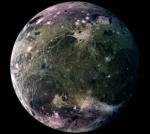 Ganymede Mosaic
4.03.1999
Ganymede, one of the four Galilean moons of Jupiter, is the largest moon in the Solar System. With a diameter of 5,260 kilometers it is even larger than planets Mercury and Pluto and just over three quarters the size of Mars. Ganymede is locked in synchronous rotation with Jupiter.
 Io's Shadow
7.10.1996
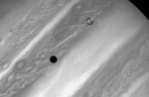
Caught in the act earlier this summer by the Hubble Space Telescope, the volcanic moon Io (above and right of center) and its shadow (black dot) are seen here against Jupiter's clouds.
 Natural Saturn On The Cassini Cruise
5.11.1998
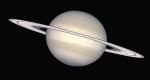
What you could see approaching Saturn aboard an interplanetary cruise ship would closely resemble this subtly shaded view of the gorgeous ringed gas giant. Processed by the Hubble Heritage project, the picture intentionally avoids...
 Releasing Compton
29.11.1995
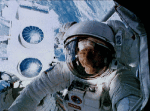
Named for Nobel laureate physicist Arthur Holly Compton, the Compton Gamma Ray Observatory (CGRO) Satellite was launched in April of 1991 aboard the Space Shuttle Atlantis. CGRO's mission is to explore the Universe at gamma-ray energies.
 A Black Hole in M87?
5.04.1997
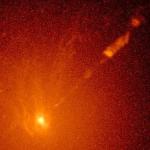
The center of nearby giant galaxy M87 is a dense and violent place. In this 1994 photograph by the Hubble Space Telescope, a disk of hot gas was found to be orbiting at the center of this massive elliptical galaxy. The disk is evident at the lower left of the picture.
|
January February |
|||||||||||||||||||||||||||||||||||||||||||||||||