
|
You entered: Earth
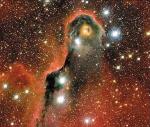 An Unusual Globule in IC 1396
25.03.2002
Is there a monster in IC 1396? Known to some as the Elephant's Trunk Nebula, parts of gas and dust clouds of this star formation region may appear to take on foreboding forms, some nearly human. The only real monster here, however, is a bright young star too far from Earth to hurt us.
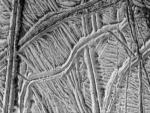 Cracks and Ridges on Europa
2.06.2002
Which way to the interstate? What appears to be a caricature of a complex highway system on Earth is actually a system of ridges and cracks on the icy surface of Jupiter's moon Europa. The distance between parallel ridges in the above photograph is typically about 1 kilometer.
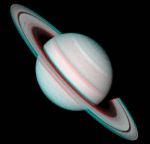 Stereo Saturn
29.10.1997
Get out your red/blue glasses and launch yourself into this stereo picture of Saturn! The picture is actually composed from two images recorded weeks apart by the Voyager 2 spacecraft during its visit to the Saturnian System in August of 1981.
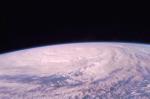 Super Typhoon Winnie
19.08.1997
Super Typhoon Winnie raged through parts of the Eastern Hemisphere last week. Swirling in the Pacific Ocean with winds in excess of 160 miler per hour, Winnie became one of the stronger storm systems in modern times: a Category 5 Hurricane.
 Adirondack Rock on Mars
21.01.2004
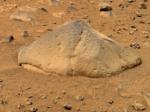
Is this a great pyramid on Mars? Actually, the pictured rock dubbed Adirondack has an irregular shape, is only about the size of a football, and has formed by natural processes. Still, its relatively large size and dust-free surface made it the first destination for the robotic Spirit rover currently roving Mars.
 Light from a Extra Solar Planet
5.04.2005
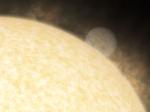
Light emitted by a planet far beyond our Solar System has been identified for the first time. The planet, illustrated in the above drawing, had its light detected by comparing the brightness of only...
 Trapezium: Teardrops in My Skies
28.02.1999
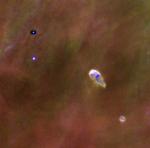
Sometimes the unexpected comes in a familiar shape. In this picture, the seemingly familiar teardrop-shaped object just right of center is actually an unusually situated disk of gas and dust. In fact, the teardrop is about the size of our own Solar System and is racing against time to condense and form planets.
 Iguacu Starry Night
14.05.2010
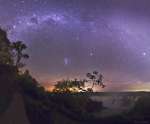
The arc of the southern Milky Way shone brightly on this starry night. Captured on May 4, in the foreground of this gorgeous skyview is the rainforest near the spectacular Iguaçu Falls and national park at the border of Brazil and Argentina.
 Globular Star Cluster 47 Tuc
16.01.2011
Globular star cluster 47 Tucanae is a jewel of the southern sky. Also known as NGC 104, it roams the halo of our Milky Way Galaxy along with some 200 other globular star clusters.
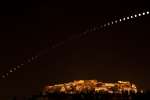 Eclipse over the Acropolis
25.06.2011
The total phase of the June 15 lunar eclipse lasted an impressive 100 minutes. Its entire duration is covered in this composite of a regular sequence of digital camera exposures, tracking the dark lunar disk as it arced above the Acropolis in Athens, Greece.
|
January February March April May June July August September October |
|||||||||||||||||||||||||||||||||||||||||||||||||