
|
You entered: Earth
 Nightlights in Qeqertaq
17.11.2023
Light pollution is usually not a problem in Qeqertaq. In western Greenland the remote coastal village boasted a population of 114 in 2020. Lights still shine in its dark skies though. During planet Earth's recent intense geomagnetic storm, on November 6 these beautiful curtains of aurora borealis fell over the arctic realm.
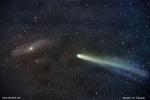 A Galaxy is not a Comet
31.01.2004
This gorgeous galaxy and comet portrait was recorded on April 5th, 2002, in the skies over the Oriental Pyrenees near Figueres, Spain. From a site above 1,100 meters, astrophotographer Juan Carlos Casado used...
 APOD: 2024 March 18 Б Comet Pons Brooks Swirling Coma
18.03.2024
A bright comet will be visible during next month's total solar eclipse. This very unusual coincidence occurs because Comet 12P/Pons-Brooks's return to the inner Solar System places it by chance only 25 degrees away from the Sun during Earth's April 8 total solar eclipse.
 EUVE Sky Map
31.01.2002
The stars beyond the Sun and the distant galaxies should be undetectable at extreme ultraviolet wavelengths. At least that was the conventional wisdom when it was first realized that the space between the stars is filled with hydrogen, a strong absorber of extreme ultraviolet light.
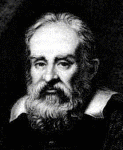 Galileo Demonstrates the Telescope
13.09.1998
Galileo Galilei made a good discovery great. Upon hearing at age 40 that a Dutch optician had invented a glass that made distant objects appear larger, Galileo crafted his own telescope and turned it toward the sky.
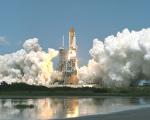 Space Shuttle Lifts Off for Space Station
23.04.2001
Last Thursday, Space Shuttle Endeavor lifted off on course for the latest round of building the International Space Station (ISS) in orbit around Earth. One of the highlights of the 11-day mission promises to be the installation of Canadarm2, a robotic arm that will assist in the future construction and utilization of the ISS.
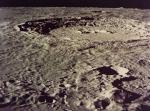 Crater Copernicus
13.05.2001
One of the more prominent craters on the Moon is named Copernicus. Copernicus is a large young crater visible with binoculars slightly northwest of the center of the Moon's Earth-facing hemisphere. Copernicus is distinguished by its size and by the many bright rays pointing out from it.
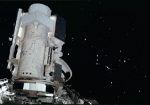 Astro 1 In Orbit
4.05.1996
In December of 1990, the Space Shuttle Columbia carried an array of astronomical telescopes high above the Earth's obscuring atmosphere to observe the Universe at ultraviolet and x-ray wavelengths. The telescopes, known...
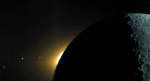 The Ecliptic Plane
27.09.1997
The Plane of the Ecliptic is illustrated in this Clementine star tracker camera image which reveals (from right to left) the Moon lit by Earthshine, the Sun's corona rising over the Moon's dark limb, and the planets Saturn, Mars, and Mercury.
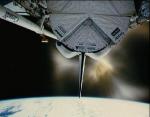 Shuttle Engine Blast
8.03.1998
The Space Shuttle Discovery's orbital maneuvering system (OMS) engine firing produced this dramatic flare as it cruised "upside down" in low Earth orbit. Discovery was named for a ship commanded by Captain James Cook RN, the 18th Century English astronomer and navigator.
|
January February March April May June July August September October |
|||||||||||||||||||||||||||||||||||||||||||||||||