
|
You entered: telescope
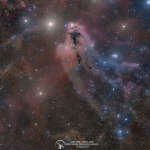 LDN 1622: Dark Nebula in Orion
22.01.2026
The silhouette of an intriguing dark nebula inhabits this cosmic scene. Lynds' Dark Nebula (LDN) 1622 appears against a faint background of glowing hydrogen gas only visible in long telescopic exposures of the region. In contrast, a brighter reflection nebula, vdB 62, is more easily seen just above the dusty dark nebula.
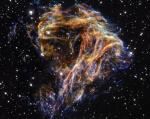 N49's Cosmic Blast
6.03.2004
Scattered debris from a cosmic supernova explosion lights up the sky in this gorgeous composited image based on data from the Hubble Space Telescope. Cataloged as N49, these glowing filaments of shocked gas span about 30 light-years in our neighboring galaxy, the Large Magellanic Cloud.
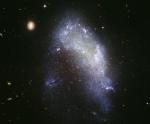 NGC 1427A: Galaxy in Motion
4.03.2005
In this tantalizing image, young blue star clusters and pink star-forming regions abound in NGC 1427A, a galaxy in motion. The small irregular galaxy's swept back outline points toward the top of this...
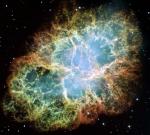 Crab Nebula Mosaic from HST
2.12.2005
The Crab Nebula is cataloged as M1, the first object on Charles Messier's famous list of things which are not comets. In fact, the cosmic Crab is now known to be a supernova remnant, an expanding cloud of debris from the death explosion of a massive star.
 GLIMPSE the Milky Way
16.12.2005
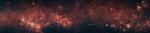
Scroll right and gaze through the dusty plane of our Milky Way Galaxy in infrared light. The cosmic panorama is courtesy of the Galactic Legacy Infrared Mid-Plane Survey Extraordinaire (GLIMPSE) project and the Spitzer Space Telescope.
 Messier Marathon
11.03.2000
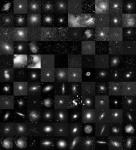
Gripped by an astronomical spring fever, it's once again time for many amateur stargazers to embark on a Messier Marathon! The Vernal Equinox occurs March 20, marking the first day of Spring for the Northern Hemisphere.
 Astronomy From An F-18
28.01.2000
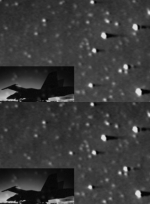
In an era of blossoming ground and space-based observatories, astronomers are also pushing the envelope with airborne instrumentation - successfully capturing an asteroid occultation from a high performance jet aircraft. This blinking animation represents...
 Dwarf Galaxies in the Coma Cluster
31.05.2007
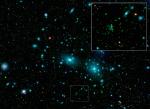
In visible light images, over a thousand galaxies are seen to lie within a volume about 20 million light-years across in the rich Coma Galaxy Cluster. But infrared images of the Coma Cluster have now been used to add thousands more to the Coma's galaxy count in the form of previously undiscovered dwarf galaxies.
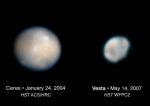 Small Worlds Ceres and Vesta
22.06.2007
Ceres and Vesta are, respectively, only around 950 kilometers and 530 kilometers in diameter - about the size of Texas and Arizona. But they are two of the largest of over 100,000 minor bodies orbiting in the main asteroid belt between Mars and Jupiter.
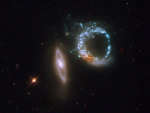 The Double Ring Galaxies of Arp 147 from Hubble
4.11.2008
How could a galaxy become shaped like a ring? Even more strange: how could two? The rim of the blue galaxy pictured on the right shows an immense ring-like structure 30,000 light years in diameter composed of newly formed, extremely bright, massive stars.
|
January February March April May |
|||||||||||||||||||||||||||||||||||||||||||||||||