
|
You entered: telescope
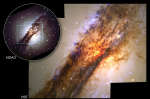 The Center of Centaurus A
6.11.2010
A fantastic jumble of young blue star clusters, gigantic glowing gas clouds, and imposing dark dust lanes surrounds the central region of the active galaxy Centaurus A. This mosaic of Hubble Space Telescope images taken in blue, green, and red light has been processed to present a natural color picture of this cosmic maelstrom.
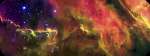 The Southern Cliff in the Lagoon
11.05.2011
Undulating bright ridges and dusty clouds cross this close-up of the nearby star forming region M8, also known as the Lagoon Nebula. A sharp, false-color composite of narrow band visible and broad band near-infrared...
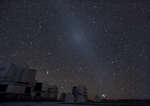 The Gegenschein Over Chile
2.12.2012
Is the night sky darkest in the direction opposite the Sun? No. In fact, a rarely discernable faint glow known as the gegenschein (German for "counter glow") can be seen 180 degrees around from the Sun in an extremely dark sky. The gegenschein is sunlight back-scattered off small interplanetary dust particles.
 M42: Inside the Orion Nebula
8.04.2014
The Great Nebula in Orion, an immense, nearby starbirth region, is probably the most famous of all astronomical nebulas. Here, glowing gas surrounds hot young stars at the edge of an immense interstellar molecular cloud only 1500 light-years away.
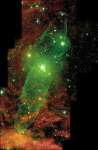 Ou4: A Giant Squid Nebula
18.07.2014
A mysterious, squid-like apparition, this nebula is very faint, but also very large in planet Earth's sky. In the mosaic image, composed with narrowband data from the 2.5 meter Isaac Newton Telescope, it spans some 2.5 full moons toward the constellation Cepheus.
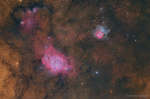 A Sagittarius Triplet
9.08.2015
These three bright nebulae are often featured in telescopic tours of the constellation Sagittarius and the crowded starfields of the central Milky Way. In fact, 18th century cosmic tourist Charles Messier cataloged two of them; M8, the large nebula left of center, and colorful M20 on the right.
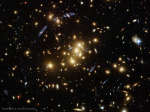 Giant Cluster Bends Breaks Images
22.08.2015
What are those strange blue objects? Many of the brightest blue images are of a single, unusual, beaded, blue, ring-like galaxy which just happens to line-up behind a giant cluster of galaxies. Cluster galaxies here typically appear yellow and -- together with the cluster's dark matter -- act as a gravitational lens.
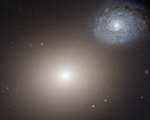 Elliptical M60, Spiral NGC 4647
27.01.2016
Giant elliptical galaxy M60 and spiral galaxy NGC 4647 do look like an odd couple in this sharp cosmic portrait from the Hubble Space Telescope. But they are found in a region of space where galaxies tend to gather, on the eastern side of the nearby Virgo Galaxy Cluster.
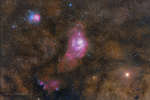 Trifid, Lagoon, and Mars
5.10.2016
Bright nebulae and star clusters along this 5 degree wide field of view are popular stops on telescopic tours of the constellation Sagittarius and the crowded starfields of the central Milky Way. Cataloged...
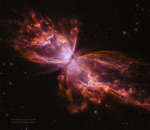 NGC 6302: The Butterfly Nebula
1.03.2019
The bright clusters and nebulae of planet Earth's night sky are often named for flowers or insects. Though its wingspan covers over 3 light-years, NGC 6302 is no exception. With an estimated surface...
|
January February March April May |
|||||||||||||||||||||||||||||||||||||||||||||||||