
|
You entered: image
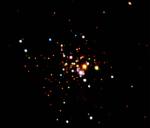 X Ray Stars of 47 Tuc
21.07.2005
Visible light images show the central region of globular cluster 47 Tucanae is closely packed, with stars less than a tenth of a light-year apart. This Chandra false-color x-ray view of central...
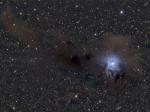 Wisps of the Iris Nebula
26.06.2007
Like delicate cosmic petals, these clouds of interstellar dust and gas have blossomed 1,300 light-years away in the fertile star fields of the constellation Cepheus. Sometimes called the Iris Nebula and dutifully cataloged as NGC 7023, this is not the only nebula in the sky to evoke the imagery of flowers.
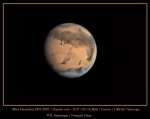 Mars in View
6.12.2007
Very good telescopic views of Mars can be expected in the coming weeks as the Red Planet nears opposition on December 24th. Of course, opposition means opposite the Sun in planet Earth's sky - an arrangement that occurs every 26 months for Mars.
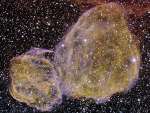 Double Supernova Remnants DEM L316
15.01.2008
Are these two supernova shells related? To help find out, the 8-meter Gemini Telescope located high atop a mountain in Chile was pointed at the unusual, huge, double-lobed cloud dubbed DEM L316. The resulting image, shown above, yields tremendous detail.
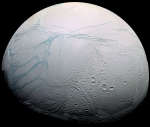 Fresh Tiger Stripes on Saturn's Enceladus
28.06.2009
Do underground oceans vent through the tiger stripes on Saturn's moon Enceladus? Long features dubbed tiger stripes are known to be spewing ice from the moon's icy interior into space, creating a cloud of fine ice particles over the moon's South Pole and creating Saturn's mysterious E-ring.
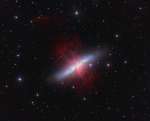 M82: Starburst Galaxy with a Superwind
4.07.2013
Also known as the Cigar Galaxy for its elongated visual appearance, M82 is a starburst galaxy with a superwind. In fact, through ensuing supernova explosions and powerful winds from massive stars, the burst of star formation in M82 is driving a prodigious outflow of material.
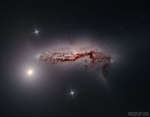 Galaxy Group Hickson 90
17.05.2017
Scanning the skies for galaxies, Canadian astronomer Paul Hickson and colleagues identified some 100 compact groups of galaxies, now appropriately called Hickson Compact Groups (HCGs). This sharp Hubble image shows one such galaxy group, HCG 90, in startling detail.
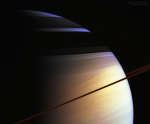 The Colors of Saturn from Cassini
30.03.2020
What creates Saturn's colors? The featured picture of Saturn only slightly exaggerates what a human would see if hovering close to the giant ringed world. The image was taken in 2005 by the robot Cassini spacecraft that orbited Saturn from 2004 to 2017.
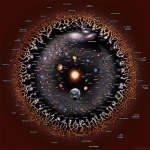 The Observable Universe
16.03.2022
How far can you see? Everything you can see, and everything you could possibly see, right now, assuming your eyes could detect all types of radiations around you -- is the observable universe. In light...
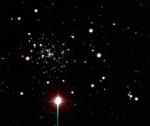 Palomar 13's Last Stand
30.11.2000
Globular star cluster Palomar 13 has roamed the halo of our Milky Way Galaxy for the last 12 billion years. The apparently sparse cluster of stars just left of center in this composite color digital image, it is one of the smallest, faintest globular clusters known.
|
January February March April May June July August September |
|||||||||||||||||||||||||||||||||||||||||||||||||