
|
You entered: image
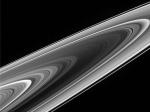 Saturns Rings from the Other Side
22.06.2005
What do Saturn's rings look like from the other side? From Earth, we usually see Saturn's rings from the same side of the ring plane that the Sun illuminates them. Geometrically...
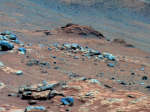 Comanche Outcrop on Mars Indicates Hospitable Past
30.08.2010
Could life once have survived on Mars? Today, neither animal nor plant life from Earth could survive for very long on Mars because at least one key ingredient -- liquid water -- is essentially absent on the red planet's rusty surface.
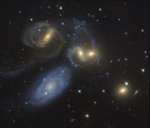 Stephan s Quintet
25.02.2012
The first identified compact galaxy group, Stephan's Quintet is featured in this eye-catching image constructed with data drawn from the extensive Hubble Legacy Archive. About 300 million light-years away, only four of these five galaxies are actually locked in a cosmic dance of repeated close encounters.
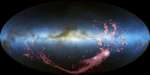 The Magellanic Stream
15.08.2013
In an astronomical version of the search for the source of the Nile, astronomers now have strong evidence for the origin of the Magellanic Stream. This composite image shows the long ribbon...
 Comet C/2025 F2 SWAN
18.04.2025
In late March, the comet now designated C/2025 F2 SWAN was found independently by citizen scientists Vladimir Bezugly, Michael Mattiazzo, and Rob Matson while examining publicly available image data from the Solar Wind ANisotropies (SWAN) camera on the sun-staring SOHO spacecraft.
 The Orion Bullets
10.01.2013
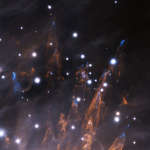
Cosmic bullets pierce the outskirts of the Orion Nebula some 1500 light-years distant in this sharp infrared close-up. Blasted out by energetic massive star formation the bullets, relatively dense, hot gas clouds about ten times the size of Pluto's orbit, are blue in the false color image.
 The Great Carina Nebula
15.10.2013
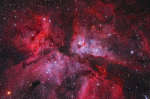
A jewel of the southern sky, the Great Carina Nebula, also known as NGC 3372, spans over 300 light-years, one of our galaxy's largest star forming regions. Like the smaller, more northerly Great...
 Voyager s Neptune
15.05.2014
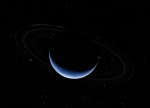
Cruising through the outer solar system, the Voyager 2 spacecraft made its closest approach to Neptune on August 25, 1989, the only spacecraft to visit the most distant gas giant. Based on the images...
 Facing NGC 6946
24.02.2018
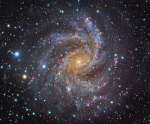
From our vantage point in the Milky Way Galaxy, we see NGC 6946 face-on. The big, beautiful spiral galaxy is located just 10 million light-years away, behind a veil of foreground dust and stars in the high and far-off constellation of Cepheus.
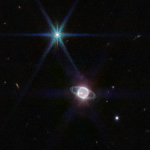 Ringed Ice Giant Neptune
23.09.2022
Ringed, ice giant Neptune lies near the center of this sharp near-infrared image from the James Webb Space Telescope. The dim and distant world is the farthest planet from the Sun, about 30 times farther away than planet Earth.
|
January February March April May June July August September |
|||||||||||||||||||||||||||||||||||||||||||||||||