
|
You entered: orbit
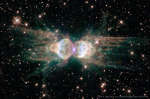 Planetary Nebula Mz3: The Ant Nebula
25.04.2015
Why isn't this ant a big sphere? Planetary nebula Mz3 is being cast off by a star similar to our Sun that is, surely, round. Why then would the gas that is streaming away create an ant-shaped nebula that is distinctly not round?
 A Total Solar Eclipse of Saros 145
10.08.2017
A darkened sky holds bright planet Venus, the New Moon in silhouette, and the shimmering corona of the Sun in this image of a total solar eclipse. A composite of simultaneous telephoto and wide angle frames it was taken in the path of totality 18 years ago, August 11, 1999, near Kastamonu, Turkey.
 APOD: 2024 May 26 Б A Solar Filament Erupts
25.05.2024
What's happened to our Sun? Nothing very unusual -- it just threw a filament. Toward the middle of 2012, a long standing solar filament suddenly erupted into space, producing an energetic coronal mass ejection (CME).
 APOD: 2025 December 8 Б Flying Over the Earth at Night
7.12.2025
Many wonders are visible when flying over the Earth at night. Such visual spectacles occur every day for astronauts in low Earth orbit, but the featured video captured several from the International Space Station (ISS) in 2011 and set them to rousing music.
 Annular Eclipse: The Ring of Fire
10.06.2002
Today, a few lucky people will see a "ring of fire." That's a name for the central view of an annular eclipse of the Sun by the Moon. At the peak of this...
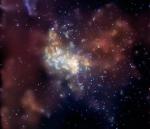 X Rays from the Galactic Core
7.01.2003
Using the orbiting Chandra X-ray Observatory, astronomers have taken this long look at the core of our Milky Way galaxy, some 26,000 light-years away. The spectacular false-color view spans about 130 light-years.
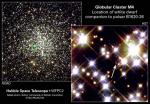 The Planet, the White Dwarf, and the Neutron Star
18.07.2003
A planet, a white dwarf, and a neutron star orbit each other in the giant globular star cluster M4, some 5,600 light-years away. The most visible member of the trio is the white...
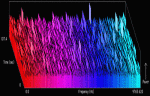 How to Search for Aliens
17.05.1999
"Mom, can I use our computer to search for aliens?" Last week, the SETI@home project released free software that enables many home computers to search for signals from intelligent extra-terrestrials. These signals may have already been detected by the huge Arecibo radio telescope
 Monitoring M2-9
18.06.2007
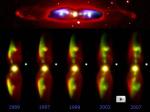
Exploring the myriad shapes found in the cosmic zoo of planetary nebulae, some astronomers have focused on the intriguing example of M2-9. About 2,100 light-years away and over one light-year across, M2-9 is known as a twin jet or butterfly nebula in reference to its striking bipolar symmetry.
 Peculiar Galaxies of Arp 273
21.04.2011
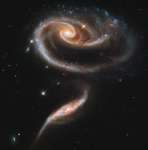
The spiky stars in the foreground of this sharp cosmic portrait are well within our own Milky Way Galaxy. The two eye-catching galaxies lie far beyond the Milky Way, at a distance of over 300 million light-years. Their distorted appearance is due to gravitational tides as the pair engage in close encounters.
|
January February March April May June July August September |
|||||||||||||||||||||||||||||||||||||||||||||||||